Ace - AI Tutor
Ask Our Educators
Textbooks
My Library
Flashcards
Scribe - AI Notes
Notes & Exams
Download App
tara clark

tara c.

Divider

Questions asked

BEST MATCH

The medical assistant is working with a patient who suddenly faints. The medical assistant checks for a pulse. No pulse is present. What should the medical assistant do next? Run for help Start CPR at a rate of 100-120 chest compressions per minute. Start CPR at a rate of 30-40 chest compressions per minute. Take the patients blood pressure and start rescue breaths

View Answer
divider
BEST MATCH

8 pts What is the most commonly seen relationship between the frequency of depressive and manic episodes in a person with bipolar disorder? Every depressive episode occurs immediately after a manic episode. The manic episodes occur twice as often as the depressive episodes. The depressive episodes occur three times as often as the manic episodes. The manic episodes only occur when medication is taken to relieve a depressive episode.

View Answer
divider
BEST MATCH

Question 6 Distinguish approximately the number of nephrons in each kidney. Select one A. Three million B. One million C. Five million D. Seven million

View Answer
divider
BEST MATCH

G $V_{DD} = +0.8 V$ D $+$ $v_{sig}$ $R_D =$ $2.7 k\Omega$ $-V_{SS} = -1 V$ $+$ $-$

View Answer
divider
BEST MATCH

4. Some radioactive nuclei, e.g. Phosphorus-32, emit electrons ("beta radioactivity"). Here we consider if Gamow's model of radioactivity can be applied to understand beta emission. 4a) As in the case of alpha emission, consider the electron to be trapped inside the original nucleus in a square well. Outside the square well, the electron will feel the Coulomb force due to the final nucleus. Write an expression for the energy of the electron as a function of the distance from the nucleus. [5 points] 4b) Sketch the potential of part a). [5 points] 4c) Discuss if Gamow's model can be applied to beta decay. [5 points]

View Answer
divider
BEST MATCH

\begin{equation} \rho^e(E) = \frac{1}{2\pi^2} \left(\frac{2m_e^*}{\hbar^2}\right)^{3/2} (E - E_g)^{1/2} \end{equation} \begin{equation} n = \int_{E_g}^{\infty} f_n(E)\rho^e(E)dE \end{equation} \begin{equation} n = \frac{1}{2\pi^2} \left(\frac{2m_e^*}{\hbar^2}\right)^{3/2} \int_{E_g}^{\infty} \exp\left[-\frac{E - E_F}{k_BT}\right](E - E_g)^{1/2}dE \end{equation} \begin{equation} n = 2 \left(\frac{m_e^*k_BT}{2\pi\hbar^2}\right)^{3/2} \exp\left(\frac{E_F}{k_BT}\right) \exp\left(-\frac{E_g}{k_BT}\right) \end{equation} \begin{equation} p = 2 \left(\frac{m_h^*k_BT}{2\pi\hbar^2}\right)^{3/2} \exp\left(-\frac{E_F}{k_BT}\right) \end{equation} \begin{equation} f^h = 1 - f^e; n = p \end{equation} \begin{equation} E_F = \frac{1}{2}E_g + \frac{3}{4}k_BTln\left(\frac{m_h^*}{m_e^*}\right) \end{equation} \begin{equation} n_i^2 = np - 4 \left(\frac{k_BT}{2\pi\hbar^2}\right)^3 (m_e^*m_h^*)^{3/2} \exp\left(-\frac{E_g}{k_BT}\right) \end{equation}

View Answer
divider
BEST MATCH

Question 3 Answer saved Marked out of 1.00 Rag question On the following graph identify the sections where the acceleration is zero. Identify all sections that apply. Velocity of a Jogger Velocity (m/s) a. A b. B c. C d. D e. E f. F g. G h. H 2.5 D 2 C 1.5 B 1 0.5 A 0 E F 10 20 30 40 50 60 G70 80 -0.5 H -1 -1.5 Time (s)

View Answer
divider
BEST MATCH

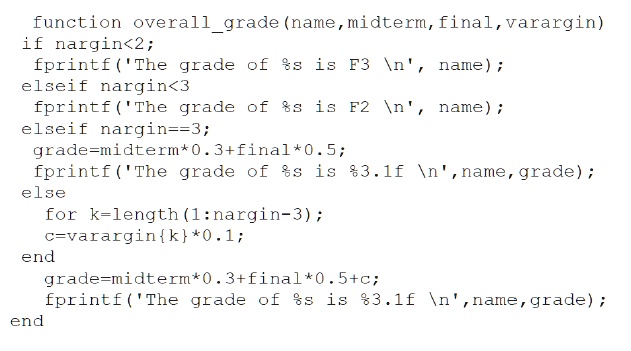
function overall_grade (name, midterm, final, varargin) if nargin<2; fprintf('The grade of %s is F3 \n', name); elseif nargin<3 fprintf('The grade of %s is F2 \n', name); elseif nargin==3; grade=midterm*0.3+final*0.5; fprintf('The grade of %s is %3.1f \n', name, grade); else for k=length(1:nargin-3); c=varargin{k}*0.1; end grade=midterm*0.3+final*0.5+c; fprintf('The grade of %s is %3.1f \n',name,grade); end
View Answer
divider
BEST MATCH

inequality: (6-2x)/(3x+2) - 0 <= 0 Simplify the inequality: (6-2x)/(3x+2) <= 0 Multiply both sides of the inequality by (3x+2) to eliminate the denominator: (6-2x) <= 0 * (3x+2) Distribute the multiplication: 6 - 2x <= 0 Simplify the inequality: -2x <= -6 Divide both sides of the inequality by -2, remembering to reverse the inequality sign since we are dividing by a negative number: x >= 3 The solution to the rational inequality is x >= 3.

View Answer
divider
BEST MATCH

For the circuit shown below, write in the space below the expression for the voltage division to calculate the value V. Write the equation in terms of the values of the circuit components given. a 39 Ω 151 Ω 403 Ω b 29 Ω For the toolbar, press ALT+F10 (PC) or ALT+FN+F10 (Mac) BIUS Paragraph Arial 14px V V AV

View Answer
divider