Welfare effects of free trade in an importing country
Consider the Panamanian market for tangerines.
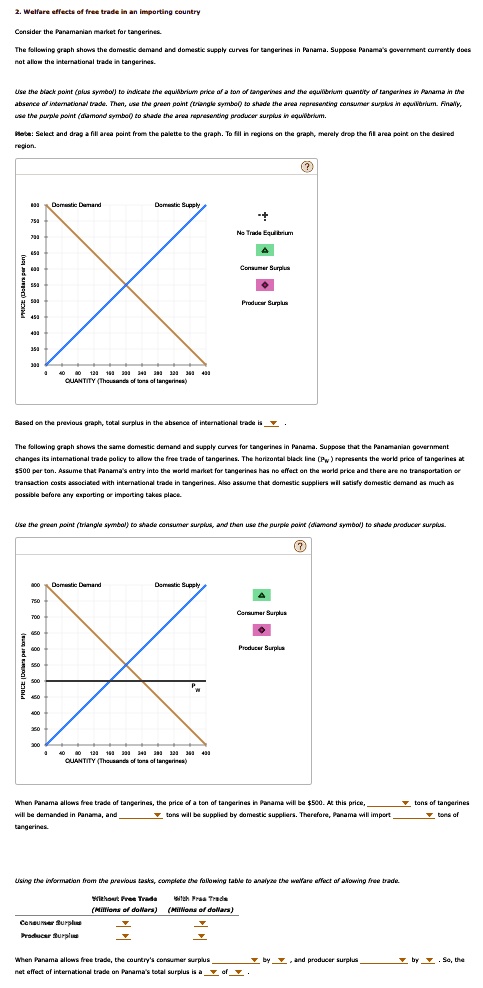
The following graph shows the domestic demand and domestic supply curves for tangerines in Panama. Suppose Panama's government currently does not allow the international trade in tangerines.
Areas of international trade. Then, use the green point (triangle symbol) to shade the area representing consumer surplus in equilibrium. Finally, use the purple point (diamond symbol) to shade the area representing producer surplus in equilibrium.
Note: Select and drag a fill area point from the palette to the graph. To fill in regions on the graph, merely drop the fill area point on the desired region.
Based on the previous graph, total surplus in the absence of international trade is grad.
The following graph shows the same domestic demand and supply curves for tangerines in Panama. Suppose that the Panamanian government changes its international trade policy to allow the free trade of tangerines. The horizontal black line (P_W) represents the world price of tangerines at $500 per ton. Assume that Panama's entry into the world market for tangerines has no effect on the world price and there are no transportation or transaction costs associated with international trade in tangerines. Also assume that domestic suppliers will satisfy domestic demand as much as possible before any exporting or importing takes place.
Use the green point (triangle symbol) to shade consumer surplus, and then use the purple point (diamond symbol) to shade producer surplus.
When Panama allows free trade of tangerines, the price of a ton of tangerines in Panama will be $500. At this price, the quantity demanded in Panama will be greater than the quantity supplied by domestic suppliers. Therefore, Panama will import tangerines.
Using the information from the previous tasks, complete the following table to analyze the welfare effects of allowing free trade in an importing country.
Consider the Panamanian market for tangerines.
The following graph does not allow the international trade in tangerines.
demand and domestic supply curves for tangerines in Panama. Use the book to shade the area representing consumer surplus in equilibrium. Finally, in color, use the absence of international trade. Then, use the green point (triangle symbol) to shade the region.
?
-
4 Consumer Surplus
4
QUANTITY (Thousands of tons)
The following graph shows domestic demand and supply curves for tangerines in Panama. Suppose the Panamanian government changes its international trade policy to allow the free trade of tangerines at $500 per ton. Panama's entry into the world market for tangerines has no effect on the world price and there are no transaction costs associated with international trade in tangerines. Domestic suppliers will satisfy domestic demand as much as possible before any exporting or importing takes place.
Use the green point (triangle symbol) to shade consumer surplus, and then use the purple point (diamond symbol) to shade producer surplus.
When Panama allows free trade of tangerines, the price will be $500. At this price, the quantity demanded of tangerines will be greater than the quantity supplied by domestic suppliers. Therefore, Panama will import tangerines.
Millions of dollars
(Millions of dollars)
Consumer and producer surplus
When Panama allows free trade of tangerines, consumer and producer surplus will increase. So, the welfare effects of free trade in an importing country are positive.