Ace - AI Tutor
Ask Our Educators
Textbooks
My Library
Flashcards
Scribe - AI Notes
Notes & Exams
Download App
taylor diaz

taylor d.

Divider

Questions asked

BEST MATCH

Question 3 When an actor speaks alone onstage during a play, it is called a: O banter O dialogue O caesura O soliloquy Question 4

View Answer
divider
BEST MATCH

Two point charges are placed 2.0 cm apart. They are fixed in place so that they do not move. (a) A small ball of charge −3.0×10⁻⁹−3.0×10⁻⁹ C is placed at point A. The ball is small enough that it can be treated as a point charge. What is the magnitude of the electric field at point A? N/C ( ± 1E7 N/C) (b) What is the direction of the electric field at point A? A. Up B. Down C. The electric field at point A does not have a direction. REMINDER: Resubmissions are not allowed on multiple choice questions. (c) What is the magnitude of the net electric force exerted on the ball? N ( ± 0.01 N) (d) What is the direction of the net electric force exerted on the ball? A. Up B. Down C. The ball does not experience an electric force. REMINDER: Resubmissions are not allowed on multiple choice questions. (e) How would your answer to parts a and b change if the ball had a charge of +3.0×10⁻⁹+3.0×10⁻⁹ C? A. Increase in magnitude B. Decrease in magnitude C. Change in Direction D. No Change REMINDER: Resubmissions are not allowed on multiple choice questions. (f) How would your answer to parts c and d change if the ball had a charge of +3.0×10⁻⁹+3.0×10⁻⁹ C? A. Increase in magnitude B. Decrease in magnitude C. Change in Direction D. No Change REMINDER: Resubmissions are not allowed on multiple choice questions. (g) Justify your answer. 500 characters remaining (h) How would your answer to parts a and b change if the ball had zero net charge? A. Increase in magnitude B. Decrease in magnitude C. Change in Direction D. No Change REMINDER: Resubmissions are not allowed on multiple choice questions. (i) How would your answer to parts c and d change if the ball had zero net charge? A. Increase in magnitude B. Decrease in magnitude C. Change in Direction D. No Change REMINDER: Resubmissions are not allowed on multiple choice questions. (j) Justify your answers.

View Answer
divider
BEST MATCH

Question 3 4 pts Which strategies are part of this experiment's design to control for confounding variables? Check all that apply. direct control random assignment use of a placebo

View Answer
divider
BEST MATCH

A nurse is teaching a newly licensed nurse about embryonic development. Which of the following statements by the newly licensed nurse shows teaching was effective?"The kidneys begin to function during week 10.""The heart begins to beat during week 4.""The trachea and bronchi form during week 6." "The brain and spinal cord form during week 7."

View Answer
divider
BEST MATCH

Question 13 What do the coronary arteries arise from? The venae cavae The myocardium The interventricular arteries The coronary sulcus The proximal end of the aorta 2 pts

View Answer
divider
BEST MATCH

Considering the details outlined in question 8 and assuming stratified sampling approach informed the random selection of the 20 graduates interns, how many of the total population of 50 interns who participated in the internship program were problably offered letters by ABC Ltd?

View Answer
divider
BEST MATCH

Week 4 Lesson 1 Discussion Why might a patient in a hospital emergency room be given type O blood? Explain your answer.

View Answer
divider
BEST MATCH

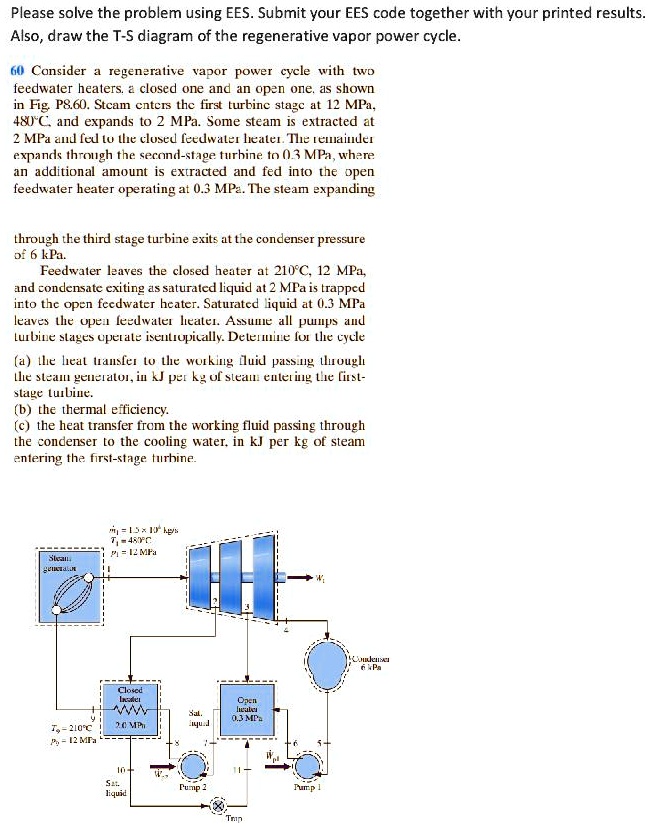
Please solve the problem using EES. Submit your EES code together with your printed results. Also, draw the T-S diagram of the regenerative vapor power cycle. 60 Consider a regenerative vapor power cycle with two feedwater heaters, a closed one and an open one, as shown in Fig. P8.60. Steam enters the first turbine stage at 12 MPa, 480°C, and expands to 2 MPa. Some steam is extracted at 2 MPa and fed to the closed feedwater heater. The remainder expands through the second-stage turbine to 0.3 MPa, where an additional amount is extracted and fed into the open feedwater heater operating at 0.3 MPa. The steam expanding through the third stage turbine exits at the condenser pressure of 6 kPa. Feedwater leaves the closed heater at 210°C, 12 MPa, and condensate exiting as saturated liquid at 2 MPa is trapped into the open feedwater heater. Saturated liquid at 0.3 MPa leaves the open feedwater heater. Assume all pumps and turbine stages operate isentropically. Determine for the cycle (a) the heat transfer to the working fluid passing through the steam generator, in kJ per kg of steam entering the first- stage turbine. (b) the thermal efficiency. (c) the heat transfer from the working fluid passing through the condenser to the cooling water, in kJ per kg of steam entering the first-stage turbine.
View Answer
divider
BEST MATCH

WMS 10.91. This problem has 20 observations from a Normal distribution. Only do parts a and b. Use a=0.05. WMS 10.92. This problem is a continuation of the previous problem. Consider the setup to question 1 with the 20 draws from a Normal distribution. Suppose instead of using the RR for the most powerful test, we use the following rejection region {Y 7.14 < g < 7.18 OR > 8}. a. Compute a for this rejection region. Round your answer to two decimal places. b. Compute the power using this rejection region for each of the alternative values of g from part (b) in WMS 10.91. What do you notice about each of the power values?

View Answer
divider
BEST MATCH

Switch the order of integration and then integrate by HAND.\\ $\int_0^{32} \int_{\sqrt{y}/4}^2 e^{x^4} dx dy$\ A correct answer will include\ will include a graph of the region of integration with the region being integrated over\ being shaded\ a rewritten integral with the order of integration switch\ all work\ Leave your answer in exact from.

View Answer
divider