Ace - AI Tutor
Ask Our Educators
Textbooks
My Library
Flashcards
Scribe - AI Notes
Notes & Exams
Download App
Tcgvkb Yvjhv

Tcgvkb Y.

Divider

Questions asked

ANSWERED

Nicole Smina verified

Numerade educator

4. Which is NOT part of Darwin's theory of natural selection? A. Living things tend to produce more offspring than can survive. B. Variations in a population exist and those variations are inherited. C. Suitable variations in a population tend to be passed on while unsuitable variations in a population are not. D. Individuals with variations suitable to their environment have shorter lifespans and produce fewer offspring. 5. Which best describes Charles Darwin theory of evolution by natural selection? A. The passing on of genes from one generation to the next B. Change in populations through time because of mutations. C. The development of characteristics by organisms in response to need. D. Change in populations through time as a response to environmental change.

View Answer
divider
ANSWERED

Nicole Smina verified

Numerade educator

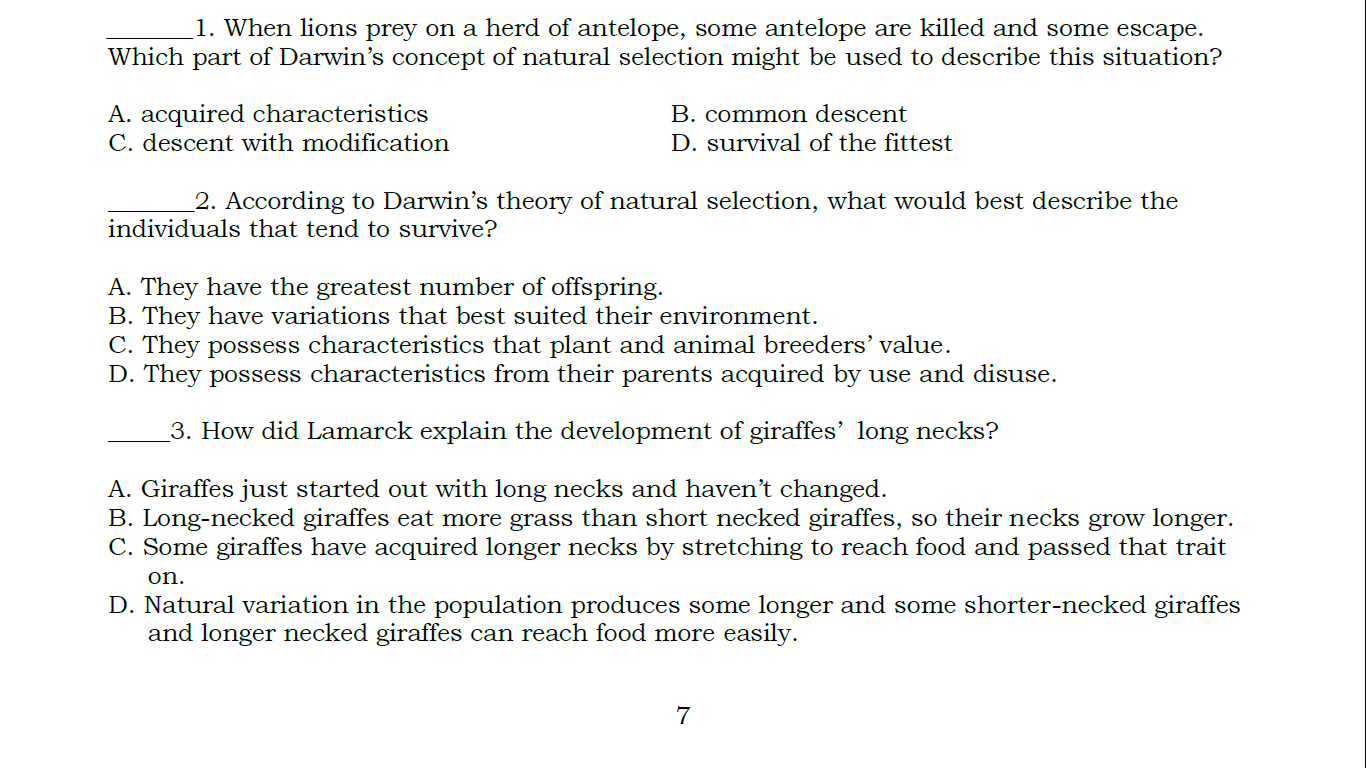
1. When lions prey on a herd of antelope, some antelope are killed and some escape. Which part of Darwin's concept of natural selection might be used to describe this situation? A. acquired characteristics B. common descent C. descent with modification D. survival of the fittest 2. According to Darwin's theory of natural selection, what would best describe the individuals that tend to survive? A. They have the greatest number of offspring. B. They have variations that best suited their environment. C. They possess characteristics that plant and animal breeders' value. D. They possess characteristics from their parents acquired by use and disuse. 3. How did Lamarck explain the development of giraffes' long necks? A. Giraffes just started out with long necks and haven't changed. B. Long-necked giraffes eat more grass than short necked giraffes, so their necks grow longer. C. Some giraffes have acquired longer necks by stretching to reach food and passed that trait on. D. Natural variation in the population produces some longer and some shorter-necked giraffes and longer necked giraffes can reach food more easily.
View Answer
divider
ANSWERED

Nicole Smina verified

Numerade educator

1. Which best describes Charles Darwin theory of evolution by natural selection? A. The number of offspring is not related to fitness. B. More offspring are produced than can possibly survive. C. The organisms that are the fittest are always largest and strongest. D. Acquired characteristics that are inherited are the cause of evolution. 2. According to Darwin's theory of natural selection, individuals who survive are the ones best adapted for their environment. Which best explains the reason why organisms survived in the changing environment? A. Organisms survived because there is a lack of competition with the species. B. Organisms survived because of the choices made by plant and animal breeders. C. Organisms survived because the possession of adaptations developed through use. D. Organisms survived because of the possession of inherited adaptations that maximize fitness. 3. Which best describes Lamarck's theory of evolution? A. Artificial selection is the basis for evolution. B. Change is the result of survival of the fittest. C. A small population size decreases the rate of evolution. D. Body structures can change according to the actions of the organism. 4 Which is NOT a part of Darwin's theory of natural selection? A. Individuals of a population vary. B. Organisms tend to over-reproduce themselves. C. There are limited resources for which individuals compete. D. Variations possessed by individuals of a population are not heritable. 5. Which best explains why there are differences in traits of organisms according to Lamarck's theory of the evolution? A. It is the result of increases in population size. B. It is the result of an unchanging local environment. C. It is the result of the actions of organisms as they change a body structure. D. It is the result of the natural variations already present within the population of organisms.

View Answer
divider
ANSWERED

Nicole Smina verified

Numerade educator

1. What can be determined between two organisms that possess similarities in structures and in their genetic code sequences? a. The organisms share a common ancestry. b. The organisms belong to the same genus. c. The organisms are native to the same geographic areas. d. The organisms will grow into anatomically similar adults. 2. A student wanted to look at DNA to study evolution. What evidence of evolution will the student use? a. Embryology c. Genetic information b. Fossil record d. Comparative anatomy 3. How do fossils provide evidence that evolution has happened on Earth? a. Fossils show that some species have gone extinct. b. Fossils show how life forms present today are different than those from the past. c. Fossils show how the sizes of certain animals has changed drastically over millions of years. d. Different sedimentary rock layers provide evidence for how the environment has changed over time. 4. Which best explains that whales descended from an ancestor that was able to walk? a. The presence of pelvis and femurs in whales. b. Whales have flatter skulls and feeding filters. c. Whales have a thick layer of fat called blubber. d. They are warm-blooded mammals who nurse their young. 5. Which is NOT an evidence for evolution? a. Many species today are just as they were when they were created. b. We can observe changes in life forms by observing the fossil record. c. Many animals have homologous structures due to common ancestry. d. Many animals have similarity in amino acid sequence from an ancestor.

View Answer
divider
ANSWERED

Supratim Pal verified

Numerade educator

1. Where can most of the fossils be found? a. Black soil c. Granite rock b. Lava flows d. Sedimentary rock 2. Which DOES NOT describe evolution? a. Evolution is continuous. c. The world is stable and unchanging. b. Evolution refers to change. d. If there is mutation, there is evolution. 3. Why do organisms with close biochemical similarities show stronger evolutionary relationships? a. They have varied and different ancestry. b. They have a common ancestor and have the same kind of proteins. c. They have similar patterns during their early stages of development. d. They possess same vestigial structure that made their evolutionary relationship closer. 4. In what Era can the oldest fossils be found? a. Cenozoic c. Paleozoic b. Mesozoic d. Pre-Cambrian 5. Which best explains the Theory of Natural Selection? a. Acquired characteristics of parents can be passed on to offspring. b. Organisms develop desirable structures to survive in a given environment. c. Organs that are not used may disappear while organs that are constantly used may develop. d. In nature, the organisms with desirable characteristics may survive while those with weaker traits may not.

View Answer
divider
ANSWERED

Crystal Wang verified

Numerade educator

2. What type of molecule is shown if a portion of a strand has a nucleotide sequence AGCAGGCAGATC? A. DNA B. mRNA C. protein D. tRNA 3. The original strand of DNA looks like this; GAC CAT GAC while the mutated strand looks like this; GAAC CAT GAC, what type of mutation is shown? A. deletion B. duplication C. inversion D. translocation 4. What causes a person with Patau Syndrome to have an extra chromosome? A. gene segregation C. non-disjunction of autosome #18 B. non-disjunction of autosome #13 D. non-disjunction of autosome #21 5. Some events that take place during the synthesis of a specific protein are listed below. Which represent the correct sequence of protein synthesis? 1. DNA serves as a template for RNA production. 2. Transfer RNA bonds to a specific codon. 3. Amino acids are bonded together. 4. RNA moves from the nucleus to the cytoplasm. 5. Messenger RNA attaches to a ribosome. A. 2 5 1 3 4 B. 4 1 5 3 2 C. 2 3 5 4 1 D. 1 4 5 2 3

View Answer
divider