Questions asked
Sanchit Jain
Numerade educator
Calculate ( int_{0}^{4} 390 e^{0.04 x} d x )
Eduard Sanchez
If the marginal revenue for ski gloves is ( M R=frac{-12}{(4 x+15)^{3}}+25 ) and ( R(0)=0 ), find the revenue function. [ R(x)= ]
Evaluate the indefinite integral and simplify so there are no negative exponents. [ intleft(frac{8}{x^{2}}+24 e^{3 x} ight) d x= ] ( square )
Ma. Theresa Alin
Given the demand function ( D(p)=200-3 p^{2} ), Find the Elasticity function [ E(p)= ] ( square ) Find the Elasticity of Demand at a price of ( $ 5 ) ( square ) At this price, we would say the demand is: Elastic Unitary Inelastic Based on this, to increase revenue we should: Raise Prices Keep Prices Unchanged Lower Prices
Use the limit definition of the derivative to find the slope of the tangent line to the curve \( f(x)=7 x^{2} \) at \( x=3 \) Evaluate each of the following and enter your answers in simplest form: Step 1 \[ f(3+h)= \] \( \square \) Step \( 2 f(3+h)-f(3)= \) \( \square \) Step \( 3 \quad \frac{f(3+h)-f(3)}{h}= \) \( \square \) Step \( 4 \lim _{h \rightarrow 0} \frac{f(3+h)-f(3)}{h}= \) \( \square \) So, \( f^{\prime}(3)= \) \( \square \)
Let \( f(x)=\left\{\begin{array}{lll}5 x+9 & \text { if } & x<3 \\ 39-5 x & \text { if } & x>3 \\ 23 & \text { if } & x=3\end{array}\right. \) Determine whether \( \mathrm{f}(\mathrm{x}) \) is continuous at \( x=3 \). If \( \mathrm{f}(\mathrm{x}) \) is not continuous, identify why. Not continuous: \( \lim _{x \rightarrow 3} f(x) \) does not exist. Not continuous: \( f(3) \) is undefined. Not continuous: \( \lim _{x \rightarrow 3} f(x) \neq f(3) \). The function is continuous at \( x=3 \).
Given \( f(x, y)=3 x^{5}+4 x y^{4}-y^{3} \), find \[ \begin{array}{l} f_{x x}(x, y)= \\ f_{x y}(x, y)= \end{array} \]
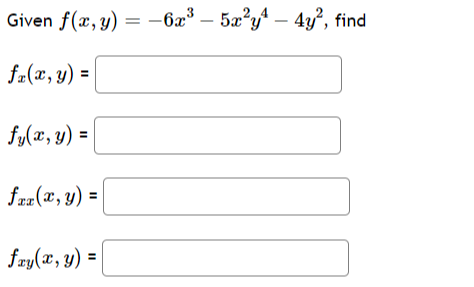
Given \( f(x, y)=-6 x^{3}-5 x^{2} y^{4}-4 y^{2} \), find \[ f_{x}(x, y)= \] \( \square \) \[ f_{y}(x, y)= \] \( \square \) \[ f_{x x}(x, y)= \] \( \square \) \[ f_{x y}(x, y)= \] \( \square \)
Given \( f(x, y)=70 x+80 y-5 x^{2}-2 y^{2}-x y \) Evaluate \( f(7,3) \) \[ f(7,3)= \]
Andrew Davis
Consider the Cobb-Douglas Production function: [ P(L, K)=20 L^{0.4} K^{0.6} ] Find the marginal productivity of labor and marginal productivity of capital when 11 units of labor and 13 units of capital are invested. (Your answers will be numbers, not functions or expressions). Give your answer to three (3) decimal places if necessary. Marginal Productivity of Labor when ( mathrm{L} ) is 11 and ( mathrm{K} ) is ( 13= ) ( square ) Marginal Productivity of Capital when ( mathrm{L} ) is 11 and ( mathrm{K} ) is ( 13= ) ( square )