Question 5.
The aerodynamic drag of an F1 car can be represented as a function of: D, V, $\rho$, $\mu$ and
L, where D is the aerodynamic drag force, V is velocity, $\rho$ is density, $\mu$ is viscosity and L
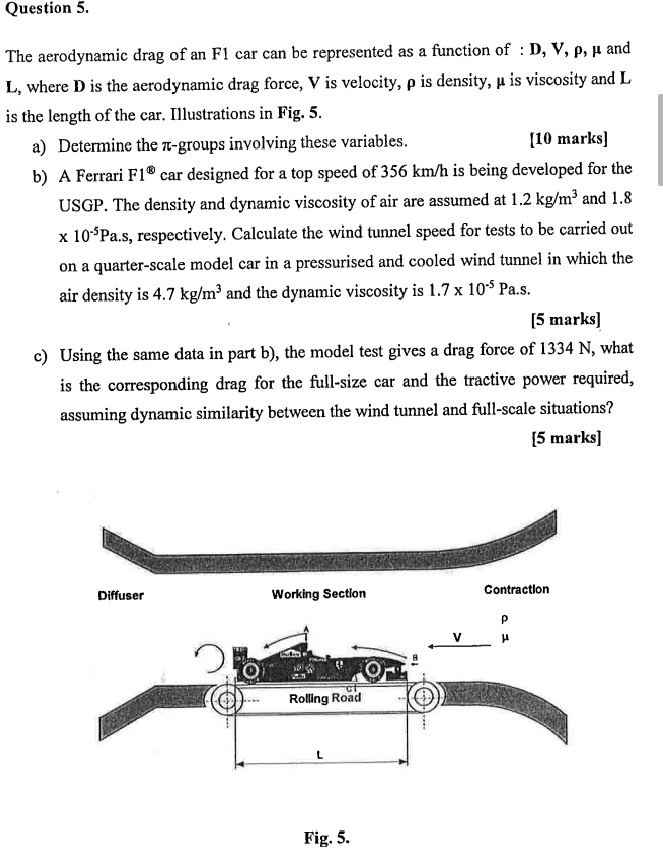
is the length of the car. Illustrations in Fig. 5.
a) Determine the $\pi$-groups involving these variables.
[10 marks]
b) A Ferrari F1® car designed for a top speed of 356 km/h is being developed for the
USGP. The density and dynamic viscosity of air are assumed at 1.2 kg/m³ and 1.8
$\times$ 10?? Pa.s, respectively. Calculate the wind tunnel speed for tests to be carried out
on a quarter-scale model car in a pressurised and cooled wind tunnel in which the
air density is 4.7 kg/m³ and the dynamic viscosity is 1.7 $\times$ 10?? Pa.s.
[5 marks]
c) Using the same data in part b), the model test gives a drag force of 1334 N, what
is the corresponding drag for the full-size car and the tractive power required,
assuming dynamic similarity between the wind tunnel and full-scale situations?
[5 marks]
Diffuser
Working Section
Contraction
$\rho$
$\mu$
Rolling Road
L
Fig. 5.