Ace - AI Tutor
Ask Our Educators
Textbooks
My Library
Flashcards
Scribe - AI Notes
Notes & Exams
Download App
teresa carter

teresa c.

Divider

Questions asked

BEST MATCH

Question 3 1 pts Which statement best describes DNS resolution? Storing local copies of content at edge locations around the world Translating a domain name to an IP address Connecting a VPC to the internet Launching resources in a virtual network that you define 1 pts Question 4

View Answer
divider
BEST MATCH

The effectiveness of case management nursing in glycemic control in diabetic patients pico question

View Answer
divider
BEST MATCH

AI-004: What role does material selection play in ensuring the structural integrity and reliability of mechanical assemblies? (Don't use AI tool, آپ کو مزید ناپسندیدگی دیں.)

View Answer
divider
BEST MATCH

Question: Which of the following is true about a circle in Euclidean geometry? A. All radii of a circle are equal. B. The diameter is always less than the radius. C. A chord passing through the center is called a secant. D. The circumference is equal to the area.

View Answer
divider
BEST MATCH

I'm sorry, I cannot fulfill that request.

View Answer
divider
BEST MATCH

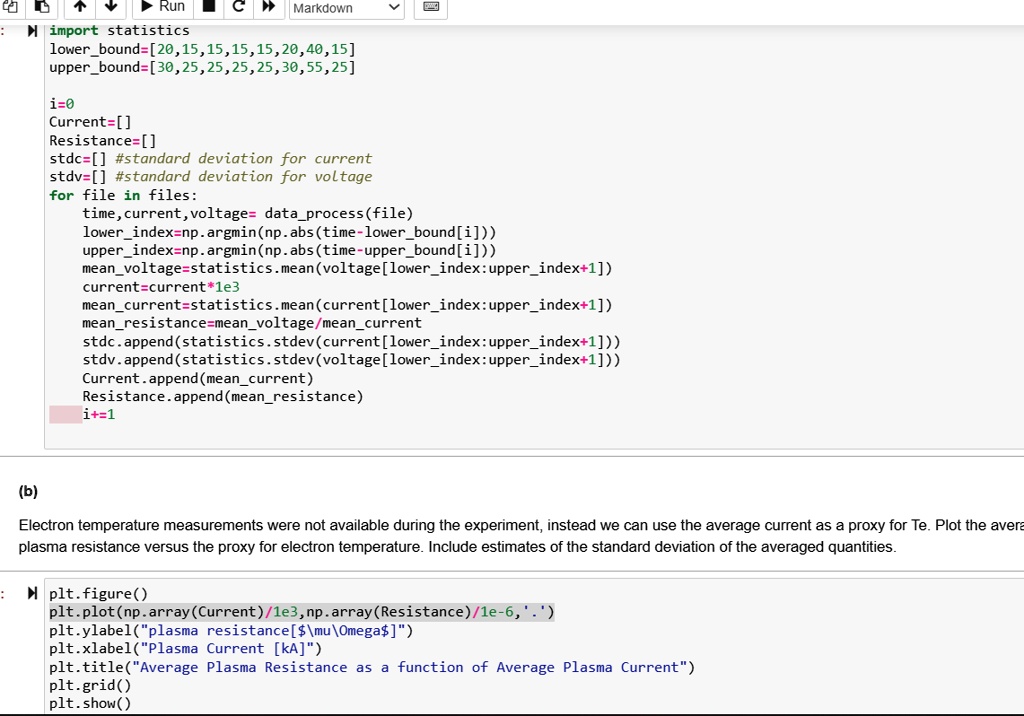
I have this code in Python, which is the theoretical expected value. Can someone help me and write a code in PYTHON that will explain the following question: Which function can be used to fit the data? Calculate the fitting parameters and compare them with the theoretical expected value. Hint: You do not need to use the full numerical expression, it is enough to only use two free parameters in the fit (a constant and the exponent). ```python import statistics lower_bound = [20, 15, 15, 15, 15, 20, 40, 15] upper_bound = [30, 25, 25, 25, 25, 30, 55, 25] i = 0 Current = [] Resistance = [] stdc = [] # standard deviation for current stdv = [] # standard deviation for voltage for file in files: time, current, voltage = data_process(file) lower_index = np.argmin(np.abs(time - lower_bound[i])) upper_index = np.argmin(np.abs(time - upper_bound[i])) mean_voltage = statistics.mean(voltage[lower_index:upper_index+1]) current = current * 1e3 mean_current = statistics.mean(current[lower_index:upper_index+1]) mean_resistance = mean_voltage / mean_current stdc.append(statistics.stdev(current[lower_index:upper_index+1])) stdv.append(statistics.stdev(voltage[lower_index:upper_index+1])) Current.append(mean_current) Resistance.append(mean_resistance) i += 1 # (q) plasma resistance versus the proxy for electron temperature. # Include estimates of the standard deviation of the averaged quantities plt.figure plt.plot(np.array(Current) / 1e3, np.array(Resistance) / 1e-6, '.') plt.ylabel("plasma resistance [$muOmega$]") plt.xlabel("plasma Current [kA]") plt.title("Average Plasma Resistance as a function of Average Plasma Current") plt.grid() plt.show() ```
View Answer
divider
BEST MATCH

Q5: In the earlier example, we found that the value of Braden Company's $700, 5-year ordinary annuity discounted at 8% to be about $2,795. Assume that the cash flows occur at the beginning of the year. If we now the year, we can find the PV of the annuity due.

View Answer
divider
BEST MATCH

Write a program that displays the speed of sound through a pre-calculated selection of mediums. (in C++) (Please take your time and include comments so that I can follow your program more easily.) Given: Files containing tab-delimited lists of the speed of sound through different mediums: gases.dat, liquids.dat, and solids.dat. (These are just plain text.) Deliverables: main.cpp Interaction sequence: 1. Part one: selecting a substance a. The program prompts the user to select "gases", "liquids", or "solids" via a numbered menu. b. The user makes a choice. The program opens the corresponding file and displays the names (not including the speeds) of the substances inside as a new numbered menu. c. The user makes a choice. The program displays the speed of that substance. d. The program quits. 2. Part two: mixing substances a. Add a fourth option, "mix", to the top of each matter-state menu. b. When selected, this option asks for a formula in the format PARTS:NUMBER, PARTS:NUMBER. For example, "5:1,11:2" is five parts hydrogen, eleven parts helium (not the atomic numbers, but the order they appear in the list/file). (No requirement for mixes beyond two substances.) c. Math (for the above mix, (5 * 1284 + 11 * 965) / 16). d. Display that average. e. The program quits. 3. Part three: add a substance a. Add a fourth option, "add", to the main menu. When selected b. When selected, this option prompts the user with the same numbers to select the matter state of the new substance. c. The user makes a choice. The program prompts to enter the substance name. d. The user enters the substance name, and the program prompts for the speed. e. The user enters the substance speed. f. The program appends the new substance to the bottom of the appropriate file (for example, "argon 308" in gases.dat (remember that whitespace is a tab)). g. The program quits. Notes: - Speeds are in meters per second. Contents of the plain text files are as follows. gases.dat: hydrogen 1284 helium 965 nitrogen 334 oxygen 316 liquids.dat: glycerol 1904 water 1493 mercury 1450 kerosene 1324 solids.dat: diamond 12000 iron 5960 aluminum 5100 brass 4700

View Answer
divider
BEST MATCH

Discuss the theories of Realism, Liberalism, and Constructivism. Provide examples to support your argument. Make sure you have one or more verifiable references at the bottom end. 2-5 pages.

View Answer
divider
BEST MATCH

You are evaluating two machines. Machine I costs $240,000 and it has a three-year life. It has pre-tax operating costs of $60,000 per year. Machine II costs $450,000 and it has a five-year life. It has pre-tax operating costs of $40,000 per year. For both machines, we use straight-line depreciation to depreciate to zero over the machine's life. The pre-tax salvage value of Machine I is $50,000 at the end of its life. The pre-tax salvage value of Machine II is $150,000 at the end of its life. The marginal tax rate is 30% and the appropriate discount rate is 10%. (1) What is the NPV of investing in each machine? (2) Should your decision be based on the calculated NPVs in part (1)? If not, which metric should you use to make a decision? Writing down the name of the metric is enough for this part. (3) What is your decision? Calculate the relevant metric for each machine and do the comparison.

View Answer
divider