3. Natural Monopoly
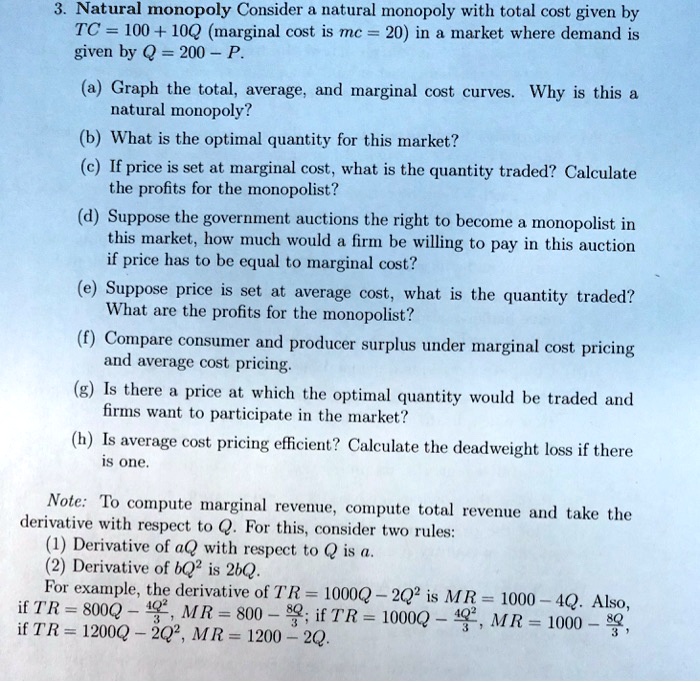
Consider a natural monopoly with total cost given by TC = 100 + 10Q (marginal cost is mc = 20 in a market where demand is given by Q = 200 - P).
a) Graph the total, average, and marginal cost curves. Why is this a natural monopoly?
b) What is the optimal quantity for this market?
c) If price is set at marginal cost, what is the quantity traded? Calculate the profits for the monopolist.
d) Suppose the government auctions the right to become a monopolist in this market, how much would a firm be willing to pay in this auction if price has to be equal to marginal cost?
e) Suppose the price is set at average cost, what is the quantity traded? What are the profits for the monopolist?
f) Compare consumer and producer surplus under marginal cost pricing and average cost pricing.
g) Is there a price at which the optimal quantity would be traded and firms want to participate in the market?
h) Is average cost pricing efficient? Calculate the deadweight loss if there is one.
Note: To compute marginal revenue, compute total revenue and take the derivative with respect to Q. For this, consider two rules:
(1) Derivative of aQ with respect to Q is a.
(2) Derivative of bQ is 2bQ.
For example, the derivative of TR = 1000Q - 2Q is MR = 1000 - 4Q. Also, if TR = 1200Q - 2Q^2, MR = 1200 - 2Q.