1.
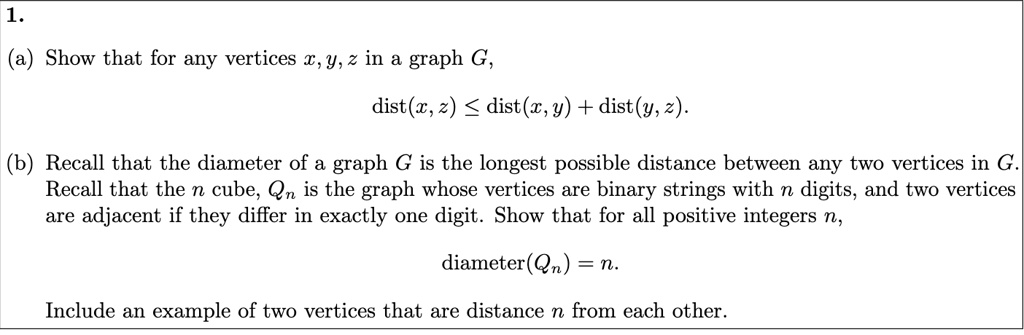
(a) Show that for any vertices x, y, z in a graph G,
dist(x, z) ? dist(x, y) + dist(y, z).
(b) Recall that the diameter of a graph G is the longest possible distance between any two vertices in G.
Recall that the n cube, Qn is the graph whose vertices are binary strings with n digits, and two vertices
are adjacent if they differ in exactly one digit. Show that for all positive integers n,
diameter(Q<sub>n</sub>) = n.
Include an example of two vertices that are distance n from each other.