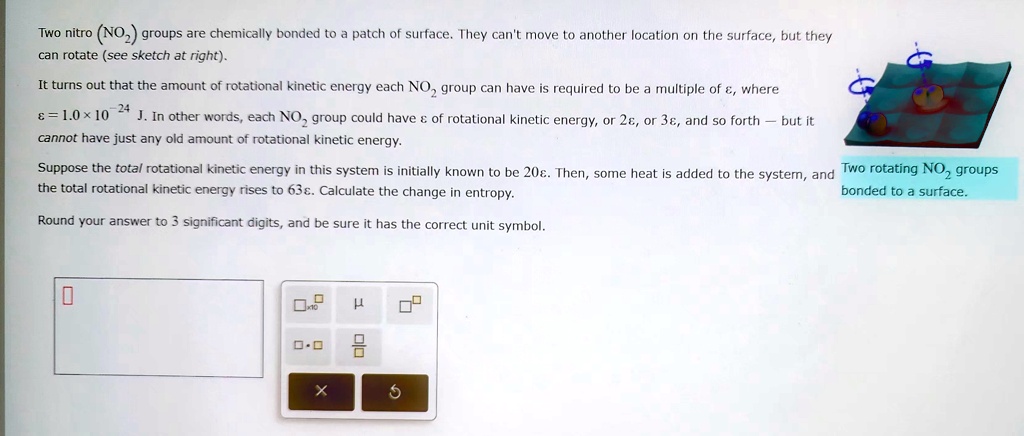
Two nitro ($NO_2$) groups are chemically bonded to a patch of surface. They can't move to another location on the surface, but they can rotate (see sketch at right).
It turns out that the amount of rotational kinetic energy each $NO_2$ group can have is required to be a multiple of $\epsilon$, where $\epsilon = 1.0 \times 10^{-24}$ J. In other words, each $NO_2$ group could have $\epsilon$ of rotational kinetic energy, or $2\epsilon$, or $3\epsilon$, and so forth — but it cannot have just any old amount of rotational kinetic energy.
Suppose the total rotational kinetic energy in this system is initially known to be $20\epsilon$. Then, some heat is added to the system, and the total rotational kinetic energy rises to $63\epsilon$. Calculate the change in entropy.
Round your answer to 3 significant digits, and be sure it has the correct unit symbol.