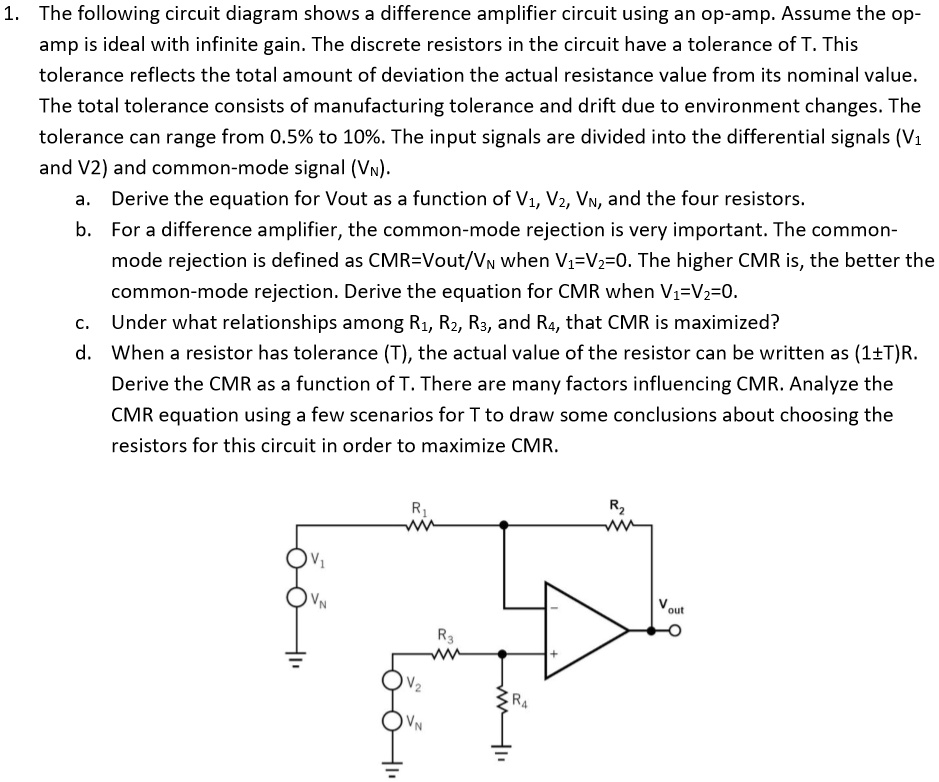
1. The following circuit diagram shows a difference amplifier circuit using an op-amp. Assume the op-
amp is ideal with infinite gain. The discrete resistors in the circuit have a tolerance of T. This
tolerance reflects the total amount of deviation the actual resistance value from its nominal value.
The total tolerance consists of manufacturing tolerance and drift due to environment changes. The
tolerance can range from 0.5% to 10%. The input signals are divided into the differential signals (V1
and V2) and common-mode signal (VN).
a. Derive the equation for Vout as a function of V1, V2, VN, and the four resistors.
b. For a difference amplifier, the common-mode rejection is very important. The common-
mode rejection is defined as CMR=Vout/VN when V1=V2=0. The higher CMR is, the better the
common-mode rejection. Derive the equation for CMR when V1=V2=0.
c. Under what relationships among R1, R2, R3, and R4, that CMR is maximized?
d. When a resistor has tolerance (T), the actual value of the resistor can be written as (1±T)R.
Derive the CMR as a function of T. There are many factors influencing CMR. Analyze the
CMR equation using a few scenarios for T to draw some conclusions about choosing the
resistors for this circuit in order to maximize CMR.