Ace - AI Tutor
Ask Our Educators
Textbooks
My Library
Flashcards
Scribe - AI Notes
Notes & Exams
Download App
teresa zimmerman

teresa z.

Divider

Questions asked

BEST MATCH

Question 28 \_\_\_\_\_ is a synthetic toxin, now banned in the U.S., sprayed for control of mosquitos in the mid 1900s. A Dioxin B PCB C Botulism D DDT

View Answer
divider
BEST MATCH

Your subject is a 136 pound female subject who is exercising on a treadmill. Her VO2 is 2.5 L/min and her RER is 0.79. This subject is exercising at how many times their resting metabolic rate? (no units required, calculate to the nearest tenth)

View Answer
divider
BEST MATCH

A person of mixed ancestry in colonial Latin America is invited to participate in the drafting of the constitution for a newly independent state. Which of the following would be his first choice?

View Answer
divider
BEST MATCH

All of the following medications are used to reduce a patient's heart rate and blood pressure, EXCEPT: A) metoprolol. B) Tenormin. C) diltiazem. D) lorazepam.

View Answer
divider
BEST MATCH

Ceteris paribus, how much consumer surplus is “lost” after the imposition of the tax – i.e. by how much does consumer surplus decrease as a result of the tax? Besides, how much does producer surplus decrease as a result of the tax?

View Answer
divider
BEST MATCH

2 1 point If an individual had an abnormal decrease in their albumin level, how would this affect the movement of fluid between the blood and surrounding tissue? More fluid would exit the blood and enter the tissue More fluid would exit the tissue and enter the blood Fluid movement would be unaffected by this situation

View Answer
divider
BEST MATCH

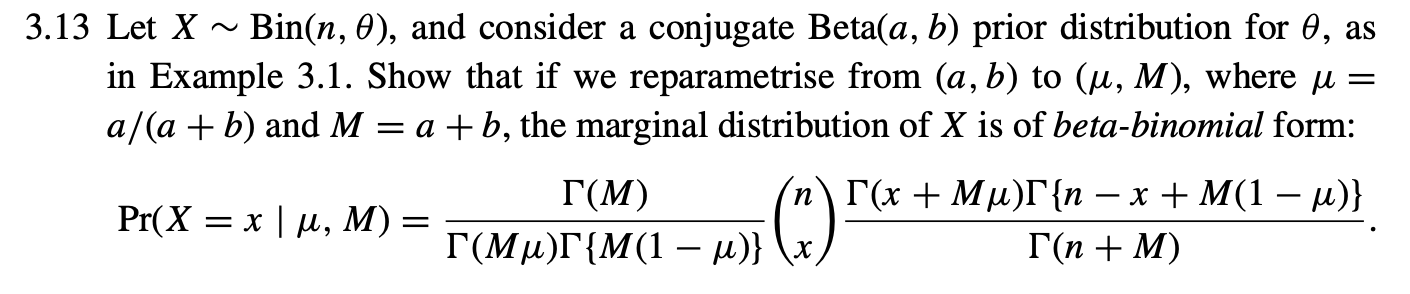
3.13 Let \( X \sim \operatorname{Bin}(n, \theta) \), and consider a conjugate \( \operatorname{Beta}(a, b) \) prior distribution for \( \theta \), as in Example 3.1. Show that if we reparametrise from \( (a, b) \) to \( (\mu, M) \), where \( \mu= \) \( a /(a+b) \) and \( M=a+b \), the marginal distribution of \( X \) is of beta-binomial form: \[ \operatorname{Pr}(X=x \mid \mu, M)=\frac{\Gamma(M)}{\Gamma(M \mu) \Gamma\{M(1-\mu)\}}\left(\begin{array}{l} n \\ x \end{array}\right) \frac{\Gamma(x+M \mu) \Gamma\{n-x+M(1-\mu)\}}{\Gamma(n+M)} \]
View Answer
divider
BEST MATCH

Which of the following cranial features would assist you with identifying a fossil belonging to genus & species: Homo neanderthalensis? Group of answer choices sagittal keel occipital bun. protruding mandibular symphysis. flaring zygomatic bones

View Answer
divider
BEST MATCH

Question 3 (1 point) Suppose that $f(x) = \frac{5}{x+2}$ and $g(x) = \frac{2}{2x-1}$ then $(f \circ f)(x)$ is a) $\frac{2}{2(\frac{5}{x+2})-1}$ b) $\frac{5}{(\frac{2}{2x-1})+2}$ c) $\frac{2}{2(\frac{2}{2x-1})-1}$ d) $\frac{5}{(\frac{5}{x+2})+2}$ e) None of the above

View Answer
divider
BEST MATCH

Texts: (23.1) Two blocks, m₁ = 20 kg and m₂ = 5 kg; an ideal rope; a frictional plane; and an ideal pulley comprise the dynamical system shown in the figure. At t = 0s, the system is in motion: m₁ moving to the right and m₂ descending. The coefficient of kinetic friction between m₁ and the plane is μ = 0.4. [Set g = 10 m/s²]. Our goal is to determine the acceleration of the system and the tension in the rope. (a) Draw free body diagrams for each of the blocks and the pulley. (b) Choose coordinates, write down Newton's Second Law for each relevant coordinate direction of each block, apply the idealized properties of the rope and the pulley to link the system together, and solve for the acceleration of the system of blocks and the tension in the rope. (23.2) Repeat (23.1) with the masses switched.

View Answer
divider