APPLICATION OF THE DISCOUNTED CASH FLOW APPROACH WHEN GROWTH IS NOT CONSTANT
2. Analysts often provide non-constant estimates of future growth. Use a modification of the discounted cash flow valuation procedure for non-
constant growth from Chapter 8 to estimate the cost of equity.
Suppose the current dividend is $2.16 per share and the current actual price that we observe is $32.00 per share. Analysts forecast growth of 11% the
first year, 10% the second year, 9% the third year, 8% the fourth year, and 7% thereafter. Estimate the cost of equity.
Step 1:
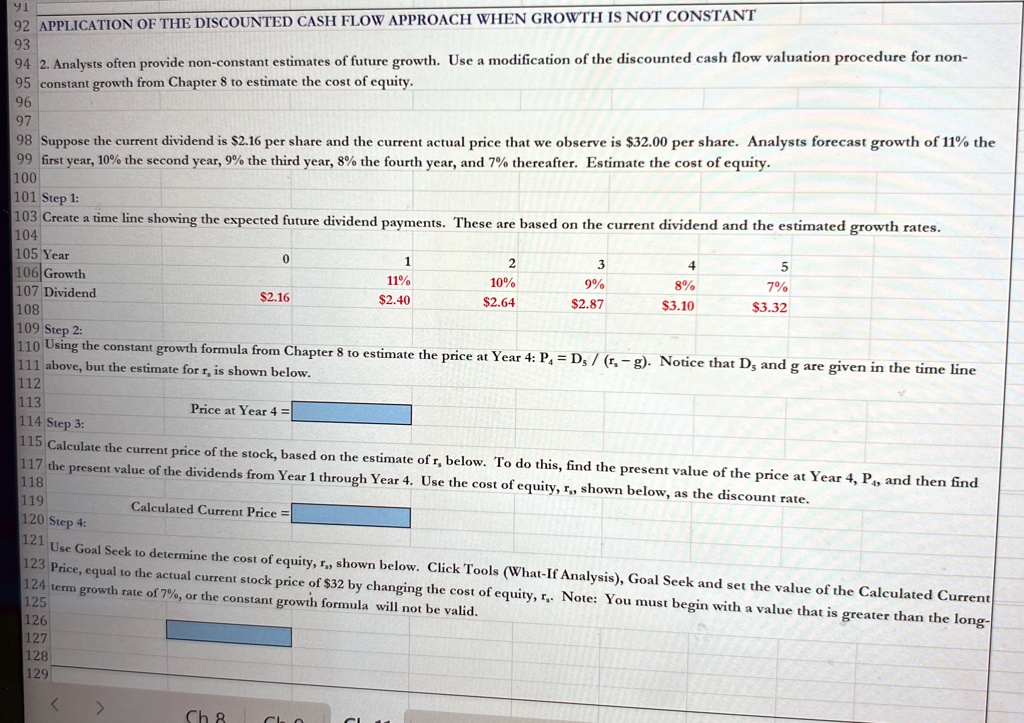
Create a time line showing the expected future dividend payments. These are based on the current dividend and the estimated growth rates.
Year
Growth
Dividend
0
$2.16
1
11%
$2.40
2
10%
$2.64
3
9%
$2.87
4
8%
$3.10
5
7%
$3.32
Step 2:
Using the constant growth formula from Chapter 8 to estimate the price at Year 4: P₁ = Ds/ (r,-g). Notice that D, and g are given in the time line
above, but the estimate for r, is shown below.
Step 3:
Price at Year 4 =
Calculate the current price of the stock, based on the estimate of r, below. To do this, find the present value of the price at Year 4, P.4, and then find
the present value of the dividends from Year 1 through Year 4. Use the cost of equity, r,, shown below, as the discount rate.
Step 4:
Calculated Current Price =
Use Goal Seek to determine the cost of equity, r,, shown below. Click Tools (What-If Analysis), Goal Seek and set the value of the Calculated Current
Price, equal to the actual current stock price of $32 by changing the cost of equity, r,. Note: You must begin with a value that is greater than the long-
term growth rate of 7%, or the constant growth formula will not be valid.