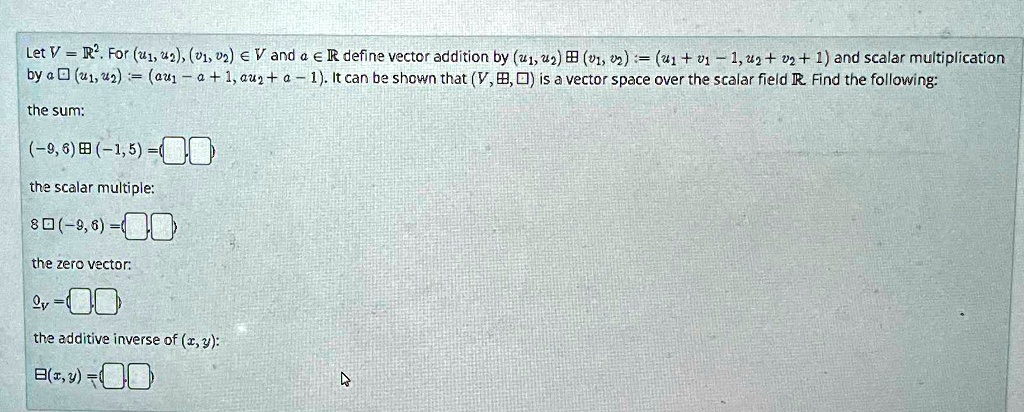
Let V = \mathbb{R}^2. For $(u_1, u_2), (v_1, v_2) \in V$ and $a \in \mathbb{R}$ define vector addition by $(u_1, u_2) \boxplus (v_1, v_2) := (u_1 + v_1 - 1, u_2 + v_2 + 1)$ and scalar multiplication by $a \boxdot (u_1, u_2) := (au_1 - a + 1, au_2 + a - 1)$. It can be shown that $(V, \boxplus, \boxdot)$ is a vector space over the scalar field \mathbb{R}. Find the following:
the sum:
$(-9, 6) \boxplus (-1, 5) = (\Box, \Box)$
the scalar multiple:
$8 \boxdot (-9, 6) = (\Box, \Box)$
the zero vector:
$0_v = (\Box, \Box)$
the additive inverse of $(x, y)$:
$\boxminus (x, y) = (\Box, \Box)$