Ace - AI Tutor
Ask Our Educators
Textbooks
My Library
Flashcards
Scribe - AI Notes
Notes & Exams
Download App
thomas bailey

thomas b.

Divider

Questions asked

BEST MATCH

45. Solve the exponential equation $5^{-n} = 125^{3n+5}$. (a) $n = -\frac{3}{2}$ (b) $n = -\frac{5}{4}$ (c) $n = -\frac{1}{2}$ (d) Not Given

View Answer
divider
BEST MATCH

The hemoglobin A1C level is elevated. This indicates? A. primary pancreatic deficiency of insuln B. long term hyperglycemia, with glucose molecules present inside red blood cells, C. Diabetic Ketoacidosis D. metabolic acidosis E. increased respiratory rate F. compensatory response to eliminate hydrogen-based metabolic acid (H+)

View Answer
divider
BEST MATCH

What are the bony landmarks of the abdomen no pelvic cavity

View Answer
divider
BEST MATCH

(a) Estimate the area under the graph of $f(x) = 10\sqrt{x}$ from $x = 0$ to $x = 4$ using four approximating rectangles and right endpoints. (Round your answers to four decimal places.) $R_4 = $ Sketch the graph and the rectangles. y 20 y 20 y 20 15 $f(x) = 10\sqrt{x}$ 15 $f(x) = 10\sqrt{x}$ 15 $f(x) = 10\sqrt{x}$ 10 5 y 20 10 5 10 5 x 1 2 3 4 00 1 2 3 4 00 1 2 3 4 15 $f(x) = 10\sqrt{x}$ 10

View Answer
divider
BEST MATCH

2.10 Give an algorithm for negating a deterministic FSA. The negation of an FSA accepts exactly the set of strings that the original FSA rejects (over the same alphabet), and rejects all the strings that the original FSA accepts. 2.11 Why doesn't your previous algorithm work with NFSAs? Now extend your algorithm to negate an NFSA.

View Answer
divider
BEST MATCH

Question 10 A normal distribution has a mean of 121 and a standard deviation of 8. Find the z-score for a data value of 117. Round to two decimal places

View Answer
divider
BEST MATCH

A drop hammer is released and falls 5 m onto a forging. Find the downward velocity of the hammer when it strikes the forging. If the forging is to be reduced by 5 mm per strike, requiring a total energy consumption of 15 kJ per strike, calculate the required mass of the hammer.

View Answer
divider
BEST MATCH

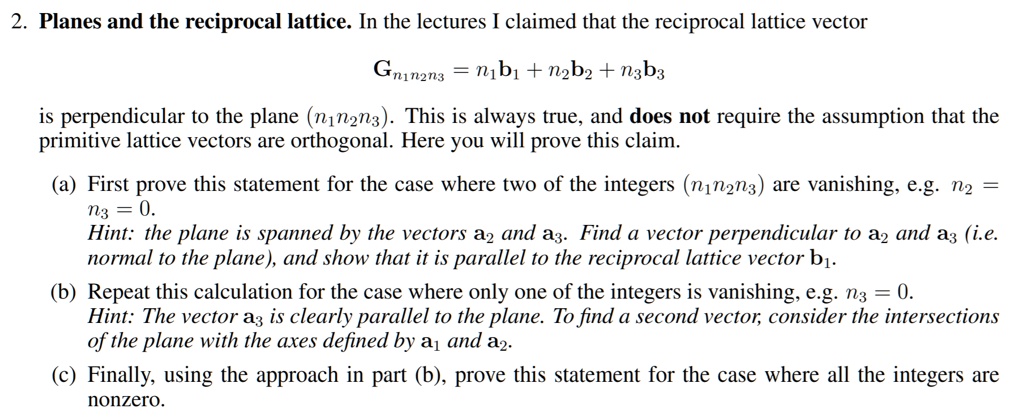
2. Planes and the reciprocal lattice. In the lectures I claimed that the reciprocal lattice vector $G_{n_1n_2n_3} = n_1b_1 + n_2b_2 + n_3b_3$ is perpendicular to the plane ($n_1n_2n_3$). This is always true, and does not require the assumption that the primitive lattice vectors are orthogonal. Here you will prove this claim. (a) First prove this statement for the case where two of the integers ($n_1n_2n_3$) are vanishing, e.g. $n_2 =$ $n_3 = 0$. Hint: the plane is spanned by the vectors $a_2$ and $a_3$. Find a vector perpendicular to $a_2$ and $a_3$ (i.e. normal to the plane), and show that it is parallel to the reciprocal lattice vector $b_1$. (b) Repeat this calculation for the case where only one of the integers is vanishing, e.g. $n_3 = 0$. Hint: The vector $a_3$ is clearly parallel to the plane. To find a second vector, consider the intersections of the plane with the axes defined by $a_1$ and $a_2$. (c) Finally, using the approach in part (b), prove this statement for the case where all the integers are nonzero.
View Answer
divider
BEST MATCH

You are considering buying a semi-annual coupon bond with a stated coupon rate of 12% (note that the stated rate is in annual terms). There are 13 years to maturity remaining on it. Your required rate of return is 13.2% per year, How much should you be willing to pay for this bond? (Round your answer to three decimal places. For example 1.23450 or 1.23463 will be rounded to 1.235 while 1.23448 will be rounded to 1.234).

View Answer
divider
BEST MATCH

Problem 6.2 - Carbon and proton emission (1 pt) a) (0.5 pt) Determine the Q-value for $^{220}Th \rightarrow ^{12}C + ^{208}Po$. Consider the Gamov factor to explain why is this type of decay hardly observed. b) (0.5 pt) List one element that undergoes proton emission and calculate its Q-value.

View Answer
divider