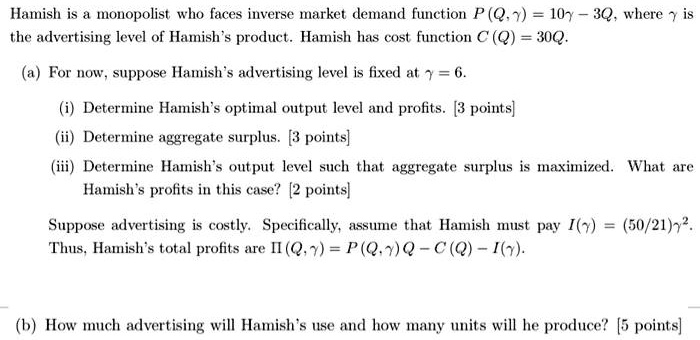
Hamish is a monopolist who faces inverse market demand function $P(Q, \gamma) = 10\gamma - 3Q$, where $\gamma$ is the advertising level of Hamish's product. Hamish has cost function $C(Q) = 30Q$.
(a) For now, suppose Hamish's advertising level is fixed at $\gamma = 6$.
(i) Determine Hamish's optimal output level and profits. [3 points]
(ii) Determine aggregate surplus. [3 points]
(iii) Determine Hamish's output level such that aggregate surplus is maximized. What are Hamish's profits in this case? [2 points]
Suppose advertising is costly. Specifically, assume that Hamish must pay $I(\gamma) = (50/21)\gamma^2$. Thus, Hamish's total profits are $\Pi(Q, \gamma) = P(Q, \gamma)Q - C(Q) - I(\gamma)$.
(b) How much advertising will Hamish's use and how many units will he produce? [5 points]