Questions asked
Draw the products of the following reaction, showing the stereoisomers that are formed. H CH$_3$ HBr CH(CH$_3$)$_2$ H$_3$C Draw the molecule(s) on the canvas by choosing buttons from the Tools (for bonds and charges), Atoms, and Templates toolbars. Show the appropriate stereochemistry by choosing the dashed or wedged buttons and then clicking a bond on the canvas.
4 5 1 point According to the VSEPR model, a molecule with the general formula AB$_5$ with one lone pair on the central atom will have a square pyramidal tetrahedral see-saw octahedral trigonal bipyramidal
A 128-Newton horizontal force is exerted upon a 6.2-kg box to move it across a level surface at a constant velocity of 2.4 m/s. The force of friction encountered by the box is ___ N?
2. (10 pts) In induction motors, the torque $T$ is decided by slip $s$, their relation are defined as: $T = \frac{15s(1-s)}{(1-s)(4s^2 - 3s + 4)}$ Use MATLAB to determine the slip at which the maximum torque occurs. Then plot the $T(s)$ function to verify your results.
Mrs. Santar wants to have a pool with a walkway. The length and width of the swimming pool are 32 m and 16 m respectively. Find the length and width of the inner rectangle.
In \triangle ABC, BC = 13 and is the longest side of the triangle. Two students need to decide if \triangle ABC is a right, obtuse, or acute triangle. Student A said the triangle is acute. Student B said it is obtuse. If $AB^2 + AC^2 < 169$, who is correct? Enter your answer and your work or explanation in the space provided
Question 6. [15 Marks] Write down the half-reactions and balance the overall disproportionation reactions that occur in basic solution. (a) Cl$_2$(g) + OH$^-$ (aq) $ ightleftharpoons$ Cl$^-$ (aq) + OCl$^-$ (aq) [3 Marks] (b) Cl$_2$(g) + OH$^-$ (aq) $ ightleftharpoons$ Cl$^-$ (aq) + ClO$_3^-$ (aq) [3 Marks] (c) P$_4$(s) + OH$^-$ (aq) $ ightleftharpoons$ PH$_3$(g) + H$_2$PO$_2^-$ (aq) [3 Marks] (d) H$_2$O$_2$(aq) $ ightleftharpoons$ O$_2$(g) + H$_2$O(l) [3 Marks] (e) NH$_3$(g) + MnO$_4^-$ (aq) $ ightleftharpoons$ N$_2$(aq) + MnO$_2$(s) [3 Marks] 7
3. [6 points] Find the \((x, y)\) points where the function \(y = \frac{\ln x}{x}\) on the interval \([1, 3]\) attains its absolute maximum and minimum values.
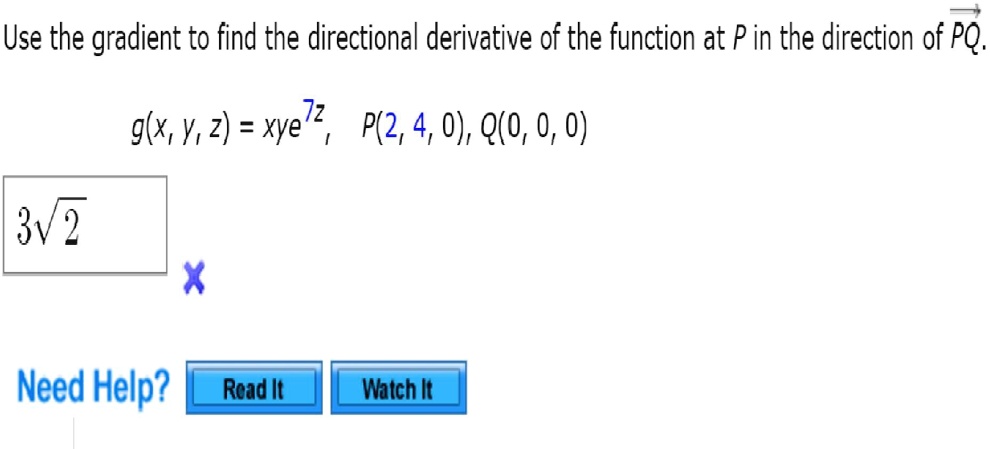
Use the gradient to find the directional derivative of the function at $P$ in the direction of $\overrightarrow{PQ}$. $g(x, y, z) = xye^{7z}$, $P(2, 4, 0)$, $Q(0, 0, 0)$
The rate constant for this zero-order reaction is 0.0200 M s$^{-1}$ at 300 $^\circ$C. A $\rightarrow$ products How long (in seconds) would it take for the concentration of A to decrease from 0.870 M to 0.340 M? t = s