Question #3:
Debt
$20 million
GDP
$40 million
Government expenditures
$5 million
Government transfer payments
$5 million
Interest payment
$1 million
Personal income tax receipts
$6 million
Corporate income tax receipts
$1 million
Contributions for social insurance
$4 million
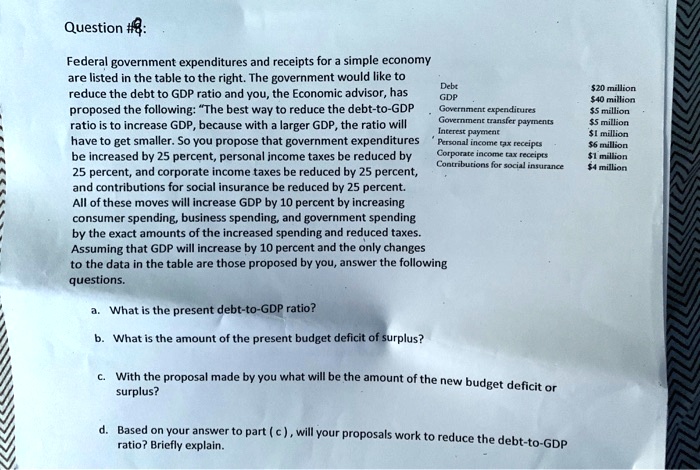
Federal government expenditures and receipts for a simple economy
are listed in the table to the right. The government would like to
reduce the debt to GDP ratio and you, the Economic advisor, has
proposed the following: "The best way to reduce the debt-to-GDP
ratio is to increase GDP, because with a larger GDP, the ratio will
have to get smaller. So you propose that government expenditures
be increased by 25 percent, personal income taxes be reduced by
25 percent, and corporate income taxes be reduced by 25 percent,
and contributions for social insurance be reduced by 25 percent.
All of these moves will increase GDP by 10 percent by increasing
consumer spending, business spending, and government spending
by the exact amounts of the increased spending and reduced taxes.
Assuming that GDP will increase by 10 percent and the only changes
to the data in the table are those proposed by you, answer the following
questions.
a. What is the present debt-to-GDP ratio?
b. What is the amount of the present budget deficit of surplus?
c. With the proposal made by you what will be the amount of the new budget deficit or
surplus?
d. Based on your answer to part (c), will your proposals work to reduce the debt-to-GDP
ratio? Briefly explain.