Ace - AI Tutor
Ask Our Educators
Textbooks
My Library
Flashcards
Scribe - AI Notes
Notes & Exams
Download App
thomas freeman

thomas f.

Divider

Questions asked

BEST MATCH

Moving to another question will save this response. Question 2 Most physician's offices perform assays designated as which complexity? O ppm O low complexity O high complexity O waived Moving to another question will save this response. Upcoming

View Answer
divider
BEST MATCH

How many bones and muscles are located within the foot and ankie? 29 & 34 26 & 30 20 & 40 25 & 35

View Answer
divider
BEST MATCH

Imagine a perfectly competitive market in which a firm produces and sells 100 units of output and makes a marginal revenue of $15. Assume that the firm now produces and sells 557 units of output. What is the firm's marginal revenue of producing and selling 557 units of output?

View Answer
divider
BEST MATCH

Consider the pseudocode below: function f(n) if n <= 2 return 4**n k = 1 for i from 1 to n for j from i to n k = 2**k + 12 return k + f((n)/(2)) + 3**f((n)/(3)) a) (10 pts) Draw the first three levels (including the root) of a recursive tree for this function. Each node should include T(.). (Level 1 (2 pts), Level 2 (4 pts), Level 3 (4 pts)) b) (15 pts) Write a recurrence relation describing the run time of this function. Recurrence Relation Claim (5 pts): Show your work below on how you got this description (hint: sum of atomic steps) (10 pts): c) (15 pts) Solve the relation and determine an asymptotic bound on the run time of this function in big O notation Asymptotic Bound Claim (5 pts): T(n) : Show your work (proof) below (10 pts): (You can continue on the next page.) Consider the pseudocode below: function f(n) if n <= 2 return 4*n k = 1 for i from 1 to E for j from i to n k = 2*k + 12 return k + f(n/2) + 3*f(n/3) a) (10 pts) Draw the first three levels (including the root) of a recursive tree for this function. Each node should include T(.). (Level 1 (2 pts), Level 2 (4 pts), Level 3 (4 pts)) b) (15 pts) Write a recurrence relation describing the run time of this function Recurrence Relation Claim (5 pts): T(n) = T(n) + T(n) + C Show your work below on how you got this description (hint: sum of atomic steps) (10 pts):

View Answer
divider
BEST MATCH

Find the limit if it exists.\\ $\lim_{x \to -8} (5x + 12)$\\ Select the correct choice below and, if necessary, fill in the answer box to complete your choice.\\ A. $\lim_{x \to -8} (5x + 12) = -28$ (Simplify your answer.)\\ B. The limit does not exist.

View Answer
divider
BEST MATCH

On the following scatter diagram of the blue sample points (circle symbols), use the orange line (square symbols) to plot the least the first orange square at the left edge of the graph (the y-intercept) and the second orange square at the value of $\hat{y}$ at the right e

View Answer
divider
BEST MATCH

Consider a circuit with three resistors, R1 = 18 Ω, R2 = 54 Ω, and R3 = 90 Ω, connected in parallel with a 24 V battery. Find the equivalent resistance.

View Answer
divider
BEST MATCH

This assignment requires your knowledge of how economic activity affects the federal budget. Relevant knowledge is important because it is important to understand that the federal budget deficit affects all aspects of the economy, but also the state of the economy affects the federal budget. Suppose that the federal budget is balanced when GDP is at potential GDP. If equilibrium GDP falls below potential, please explain how and why government transfer payments would change; how and why tax receipts would change; how and why the budget would change. For this assignment, you will be assessed on the following criteria: - Discusses how transfer payments change - Discusses how tax receipts change - Discusses how the budget changes - Writing is clear and organized, and APA format is correct.

View Answer
divider
BEST MATCH

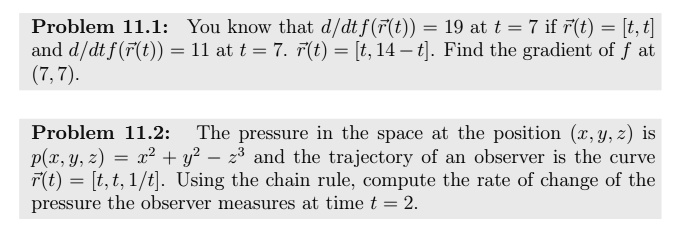
Problem 11.1: You know that $d/dt f(\vec{r}(t)) = 19$ at $t = 7$ if $\vec{r}(t) = [t, t]$ \\ and $d/dt f(\vec{r}(t)) = 11$ at $t = 7$. $\vec{r}(t) = [t, 14 - t]$. Find the gradient of $f$ at \\ $(7, 7)$. \\ Problem 11.2: The pressure in the space at the position $(x, y, z)$ is \\ p$(x, y, z) = x^2 + y^2 - z^3$ and the trajectory of an observer is the curve \\ $\vec{r}(t) = [t, t, 1/t]$. Using the chain rule, compute the rate of change of the \\ pressure the observer measures at time $t = 2$.
View Answer
divider
BEST MATCH

29-1 What is the main distinction between a GTO and a thyristor? 29-2 Explain why a GTO cannot be used in a high-frequency PWM converter.

View Answer
divider