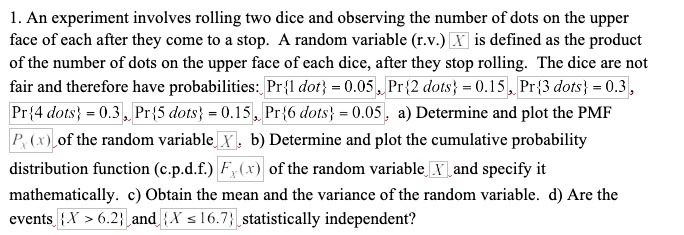
1. An experiment involves rolling two dice and observing the number of dots on the upper
face of each after they come to a stop. A random variable (r.v.) $X$ is defined as the product
of the number of dots on the upper face of each dice, after they stop rolling. The dice are not
fair and therefore have probabilities: $Pr\{1 \text{ dot}\} = 0.05$, $Pr\{2 \text{ dots}\} = 0.15$, $Pr\{3 \text{ dots}\} = 0.3$,
$Pr\{4 \text{ dots}\} = 0.3$, $Pr\{5 \text{ dots}\} = 0.15$, $Pr\{6 \text{ dots}\} = 0.05$, a) Determine and plot the PMF
$P_X(x)$ of the random variable $X$, b) Determine and plot the cumulative probability
distribution function (c.p.d.f.) $F_X(x)$ of the random variable $X$ and specify it
mathematically. c) Obtain the mean and the variance of the random variable. d) Are the
events {$X > 6.2$} and {$X \le 16.7$} statistically independent?