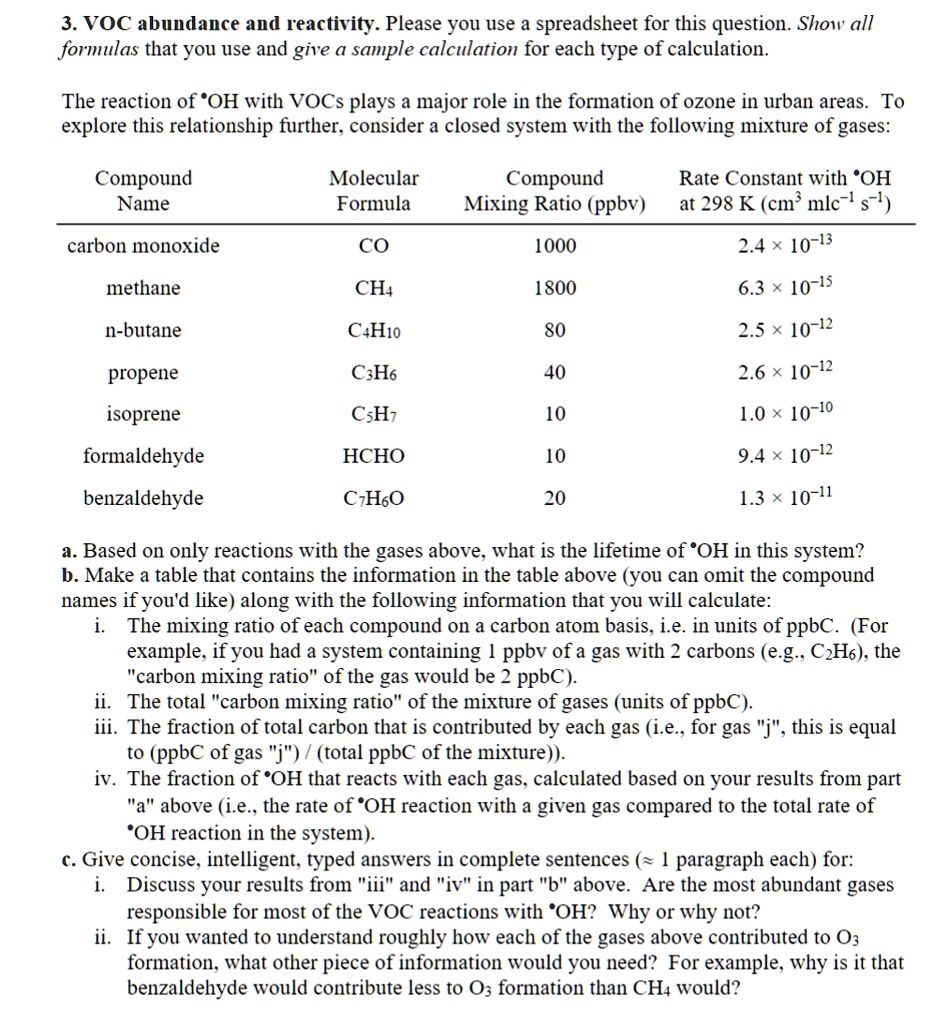
VOC abundance and reactivity. Please use a spreadsheet for this question. Show all formulas that you use and give a sample calculation for each type of calculation.
The reaction of OH with VOCs plays a major role in the formation of ozone in urban areas. To explore this relationship further, consider a closed system with the following mixture of gases:
a. Based on only reactions with the gases above, what is the lifetime of OH in this system?
b. Make a table that contains the information in the table above (you can omit the compound names if you'd like) along with the following information that you will calculate:
i. The mixing ratio of each compound on a carbon atom basis, i.e. in units of ppbC. (For example, if you had a system containing 1 ppbv of a gas with 2 carbons (e.g., CH6), the "carbon mixing ratio" of the gas would be 2 ppbC).
ii. The total "carbon mixing ratio" of the mixture of gases (units of ppbC).
iii. The fraction of total carbon that is contributed by each gas (i.e., for gas "j", this is equal to (ppbC of gas "j") / (total ppbC of the mixture)).
iv. The fraction of OH that reacts with each gas, calculated based on your results from part "a" above (i.e., the rate of OH reaction with a given gas compared to the total rate of OH reaction in the system).
c. Give concise, intelligent, typed answers in complete sentences paragraph each
3. VOC abundance and reactivity. Please use a spreadsheet for this question. Show all formulas that you use and give a sample calculation for each type of calculation.
The reaction of OH with VOCs plays a major role in the formation of ozone in urban areas. To explore this relationship further, consider a closed system with the following mixture of gases:
Compound Name Molecular Formula Compound Rate Constant with OH at 298 K (cm3 mlc-1 s-1) Mixing Ratio (ppbv) carbon monoxide Co 1000 2.4 x 10⁻¹³ 6.3 x 10⁻¹⁵ 2.5 x 10⁻¹² 2.6 x 10⁻¹² 1.0 x 10⁻¹⁰ 9.4 x 10⁻¹² 1.3 x 10⁻¹¹ methane CH4 1800 n-butane C4H10 80 propene C3H6 40 isoprene CsH7 10 formaldehyde HCHO 10 benzaldehyde C?H6O 20
a. Based on only reactions with the gases above, what is the lifetime of OH in this system? b. Make a table that contains the information in the table above (you can omit the compound names if you'd like) along with the following information that you will calculate: i. The mixing ratio of each compound on a carbon atom basis, i.e. in units of ppbC. (For example, if you had a system containing 1 ppbv of a gas with 2 carbons (e.g., CH6), the "carbon mixing ratio" of the gas would be 2 ppbC). ii. The total "carbon mixing ratio" of the mixture of gases (units of ppbC). iii. The fraction of total carbon that is contributed by each gas (i.e., for gas "j", this is equal to (ppbC of gas "j") / (total ppbC of the mixture) iv. The fraction of OH that reacts with each gas, calculated based on your results from part "a" above (i.e., the rate of OH reaction with a given gas compared to the total rate of OH reaction in the system). c. Give concise, intelligent, typed answers in complete sentences paragraph each for i. Discuss your results from "iii" and "iv" in part "b" above. Are the most abundant gases responsible for most of the VOC reactions with OH? Why or why not? ii. If you wanted to understand roughly how each of the gases above contributed to O3 formation, what other piece of information would you need? For example, why is it that benzaldehyde would contribute less to O3 formation than CH4 would?