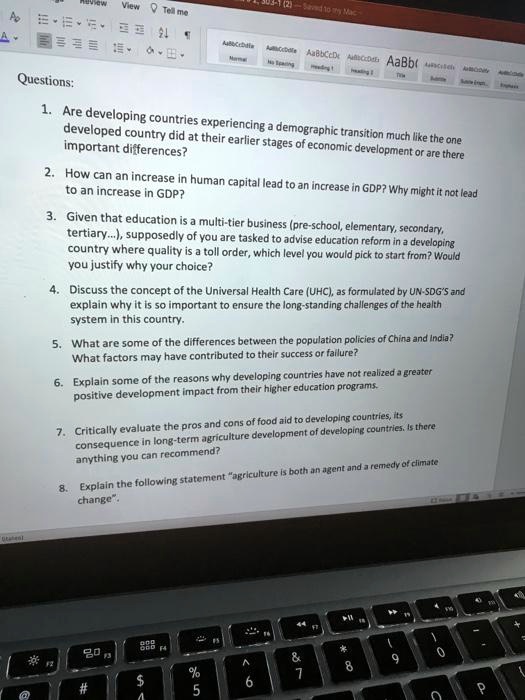
Questions:
1. Are developing countries experiencing a demographic transition much like the one
developed country did at their earlier stages of economic development or are there
important differences?
2. How can an increase in human capital lead to an increase in GDP? Why might it not lead
to an increase in GDP?
3. Given that education is a multi-tier business (pre-school, elementary, secondary,
tertiary...), supposedly of you are tasked to advise education reform in a developing
country where quality is a toll order, which level you would pick to start from? Would
you justify why your choice?
4. Discuss the concept of the Universal Health Care (UHC), as formulated by UN-SDG'S and
explain why it is so important to ensure the long-standing challenges of the health
system in this country.
5. What are some of the differences between the population policies of China and India?
What factors may have contributed to their success or failure?
6. Explain some of the reasons why developing countries have not realized a greater
positive development impact from their higher education programs.
7. Critically evaluate the pros and cons of food aid to developing countries, its
consequence in long-term agriculture development of developing countries. Is there
anything you can recommend?
8. Explain the following statement "agriculture is both an agent and a remedy of climate
change".