Recitation #7. Natural Selection and Fitness
Short-Answer
Bernard Kettlewell studied a population of Peppered moths (Biston betularia) and found a shift from white and light colors (typica morph) to darker moths (carbonaria morph) in the population. This was thought to be an adaptation from the industrial revolution that blackened the tree trunks of the moths' habitat. Suppose that this mutation is controlled by a single diploid locus, with the light coloration allele (L) dominant over the dark coloration allele (l). In a wild population of Peppered moths, there are 228 typica moths and 787 carbonaria morphs, for a total of 1015 peppered moths. You calculated the genotype and allele frequencies using HWE formula and wrote them in the table.
Reminder: Numbers and situations in questions are often changed every semester, resulting in different outcomes.
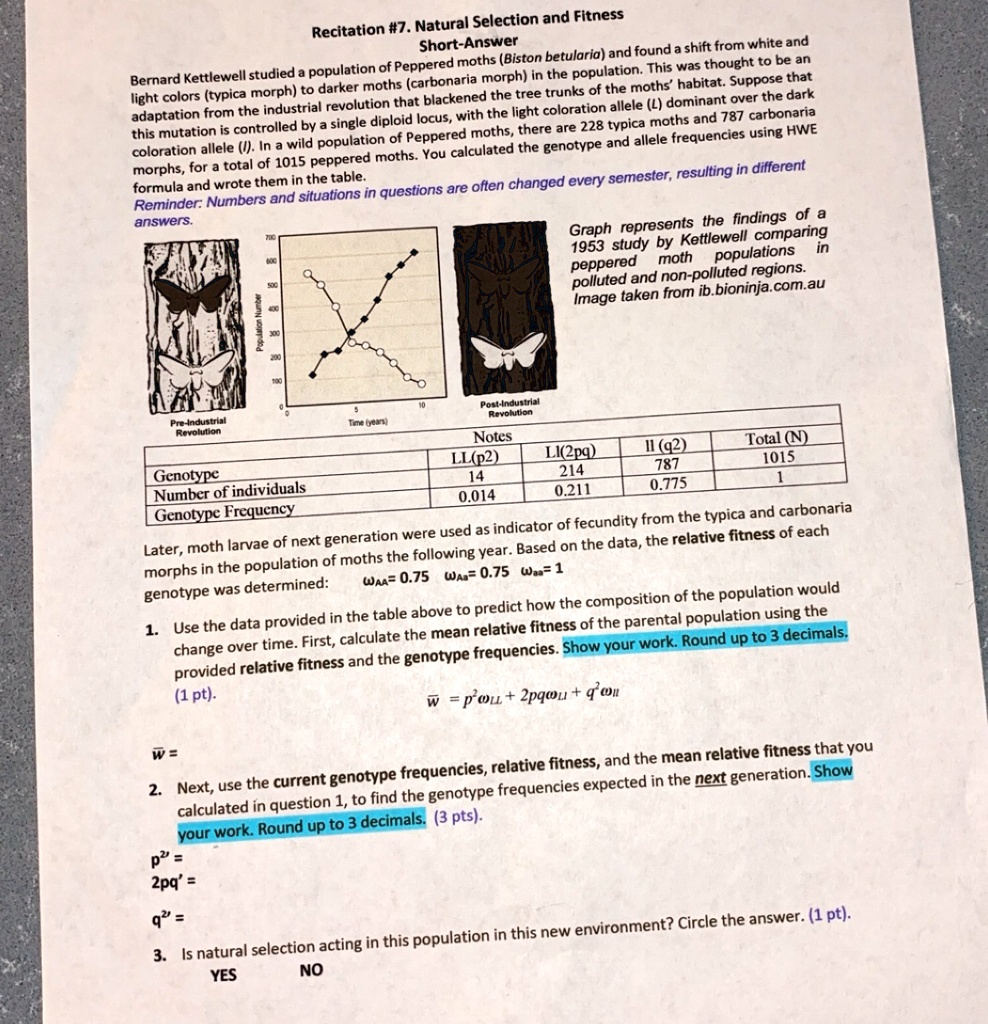
Graph represents the findings of a 1953 study by Kettlewell comparing peppered moth populations in polluted and non-polluted regions. Image taken from ib.bioninja.com.au
able[[,Notes,,,],[Genotype,LL(p^2),Ll(2pq),ll(q^2),Total (N)],[Number of individuals,14,214,787,1015],[Genotype Frequency,0.014,0.211,0.775,1]]
Later, moth larvae of the next generation were used as an indicator of fecundity from the typica and carbonaria morphs in the population of moths the following year. Based on the data, the relative fitness of each genotype was determined: ,omega_{LL}=0.75,omega_{Ll}=0.75,omega_{ll}=1
Use the data provided in the table above to predict how the composition of the population would change over time. First, calculate the mean relative fitness of the parental population using the provided relative fitness and the genotype frequencies. Show your work. Round up to 3 decimals. (1 pt).
�ar{w}=p^{2}omega_{LL}+2pqomega_{Ll}+q^{2}omega_{ll}
�ar{w}=
Next, use the current genotype frequencies, relative fitness, and the mean relative fitness that you calculated in question 1, to find the genotype frequencies expected in the next generation. Show your work. Round up to 3 decimals. (3 pts).
p^{2y}=
2pq^{'}=
q^{2y}=
Is natural selection acting in this population in this new environment? Circle the answer. (1 pt).
YES
NO