Ace - AI Tutor
Ask Our Educators
Textbooks
My Library
Flashcards
Scribe - AI Notes
Notes & Exams
Download App
thomas mar-

thomas m.

Divider

Questions asked

BEST MATCH

explain to the parents of the patient a detailed lesson on Nervous System Cells, Nervous System Tissue and the steps of an Action Potential.

View Answer
divider
BEST MATCH

Multiplication involving binomials and trinomials in one variable Multiply. (x^(2)+5x+7)(2x-6) Simplify your answer.

View Answer
divider
BEST MATCH

Stephen Nathanson argues that the Principle of Proportionality in Punishment –

View Answer
divider
BEST MATCH

Question 23 Imagine that Lauren deposits \$12,000 of currency into her checking account deposit at Fifth Third Bank and that the required reserve ratio is 18%. As a result, of Lauren's deposit, Fifth Third Bank's required reserves increase by

View Answer
divider
BEST MATCH

Which area of the limbic system has considerable influence on the secretion of hormones throughout the body? the hypothalamus the amygdala the hippocampus the thalamus

View Answer
divider
BEST MATCH

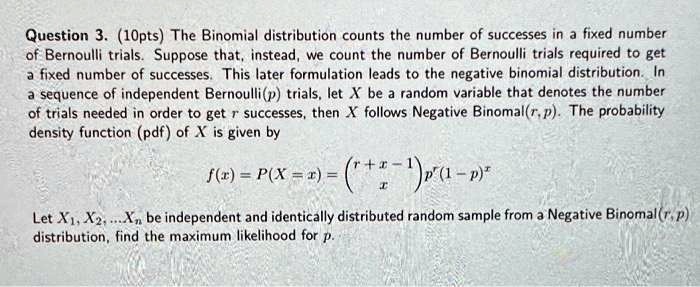
Question 3. (10pts) The Binomial distribution counts the number of successes in a fixed number of Bernoulli trials. Suppose that, instead, we count the number of Bernoulli trials required to get a fixed number of successes. This later formulation leads to the negative binomial distribution. In a sequence of independent Bernoulli ($p$) trials, let $X$ be a random variable that denotes the number of trials needed in order to get $r$ successes, then $X$ follows Negative Binomal($r$, $p$). The probability density function (pdf) of $X$ is given by $f(x) = P(X = x) = \binom{r + x - 1}{x} p^r (1 - p)^x$ Let $X_1, X_2,...X_n$ be independent and identically distributed random sample from a Negative Binomal($r$, $p$) distribution, find the maximum likelihood for $p$.
View Answer
divider
BEST MATCH

Problem 1) A cantilever beam 10 ft long carries a uniformly distributed load of w= 100 lb/ft. The beam is constructed from a 3-in.-wide by 8-in.-deep wood timber (1) that is reinforced on its upper surface by a 3-in.-wide by 0.25-in.-thick aluminum plate (2). The elastic modulus of the wood is E = 1,700 ksi, and the elastic modulus of the aluminum plate is E = 10,200 ksi. Determine the maximum bending stresses produced in timber (1) and aluminum plate (2).

View Answer
divider
BEST MATCH

Verify Green's Theorem by evaluating both integrals $\int_C y^2 dx + x^2 dy = \iint_R \left(\frac{\partial N}{\partial x} - \frac{\partial M}{\partial y}\right) dA$ for the given path. C: rectangle with vertices (0, 0), (3, 0), (3, 5), and (0, 5) $\int_C y^2 dx + x^2 dy = $ $\iint_R \left(\frac{\partial N}{\partial x} - \frac{\partial M}{\partial y}\right) dA = $

View Answer
divider
BEST MATCH

An exponential equation is a nonlinear regression equation of the form $y = ab^x$. Use technology to find and graph the exponential equation for the accompanying data, which shows the number of bacteria present after a certain number of hours. Include the original data in the graph. Note that this model can also be found by solving the equation $log y = mx + b$ for $y$. Click the icon to view the table of numbers of hours and bacteria. The equation of the regression curve is $y = \boxed{} \boxed{}^x$ (Round to two decimal places as needed.) Time and Bacteria Count Number of hours, $x$ Number of bacteria, $y$ 1 166 2 280 3 468 4 783 5 1314 6 1915 7 4906 Print Done

View Answer
divider
BEST MATCH

(2) This question works out the basics of stellar tidal disruption by supermassive black holes. We won't cover this in detail in class, but it can be worked out from quite basic Newtonian gravity principles. A star of radius $r_\ast$ and mass $m_\ast$ approaches at distance $d \gg r_\ast$, a black hole of mass $M_{BH}$. By considering the difference in the gravitational force from the black hole at distance $d$ and distance ($d + r_\ast$), find an expression for the tidal force that would tend to rip the star apart. (In the appropriate limit where $d \gg r_\ast$, you should be able to simplify this to a form that scales as $r_\ast/d^3$.) By comparing the tidal force due to the black hole to the force of self-gravity that is trying to hold the star together, show that the tidal force will win and the star will be destroyed if, $d < \left(\frac{M_{BH}}{m_\ast}\right)^{1/3} r_\ast$. (Up to numerical constants that aren't too important.) Calculate this tidal radius in units of the Schwarzschild radius for a Solar-type star approaching the supermassive black hole in the Galactic Center.

View Answer
divider