Physics 335
Credit: Michael Loverude
III. Pressure in the particulate model
In a particulate model of gases, we can account for the pressure by considering collisions of gas particles
with the container walls. Specifically, the value of the pressure is given by the product of the following
two quantities:
• the average magnitude of the change in momentum of a particle in a collision with a wall
• the number of particles colliding with the wall per unit time and unit area
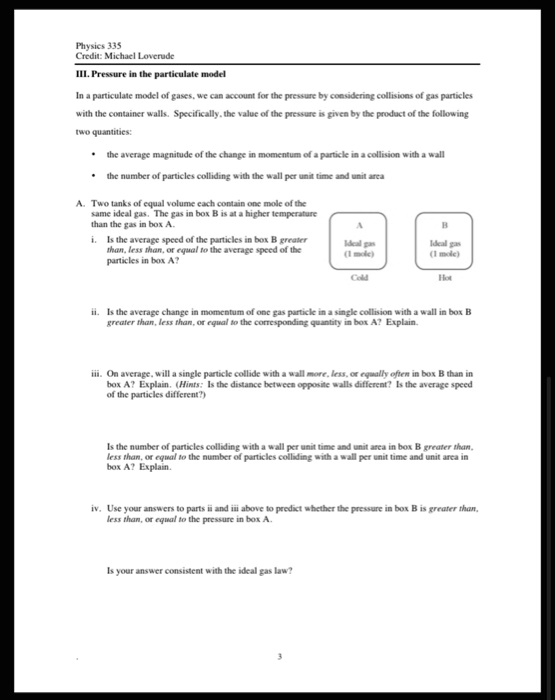
A. Two tanks of equal volume each contain one mole of the
same ideal gas. The gas in box B is at a higher temperature
than the gas in box A.
i. Is the average speed of the particles in box B greater
than, less than, or equal to the average speed of the
particles in box A?
A
B
Ideal gas
(1 mole)
Ideal gas
(1 mole)
Cold
Hot
ii. Is the average change in momentum of one gas particle in a single collision with a wall in box B
greater than, less than, or equal to the corresponding quantity in box A? Explain.
iii. On average, will a single particle collide with a wall more, less, or equally often in box B than in
box A? Explain. (Hints: Is the distance between opposite walls different? Is the average speed
of the particles different?)
Is the number of particles colliding with a wall per unit time and unit area in box B greater than,
less than, or equal to the number of particles colliding with a wall per unit time and unit area in
box A? Explain.
iv. Use your answers to parts ii and iii above to predict whether the pressure in box B is greater than,
less than, or equal to the pressure in box A.
Is your answer consistent with the ideal gas law?
3