Molecules by Acme
The Molecular Model
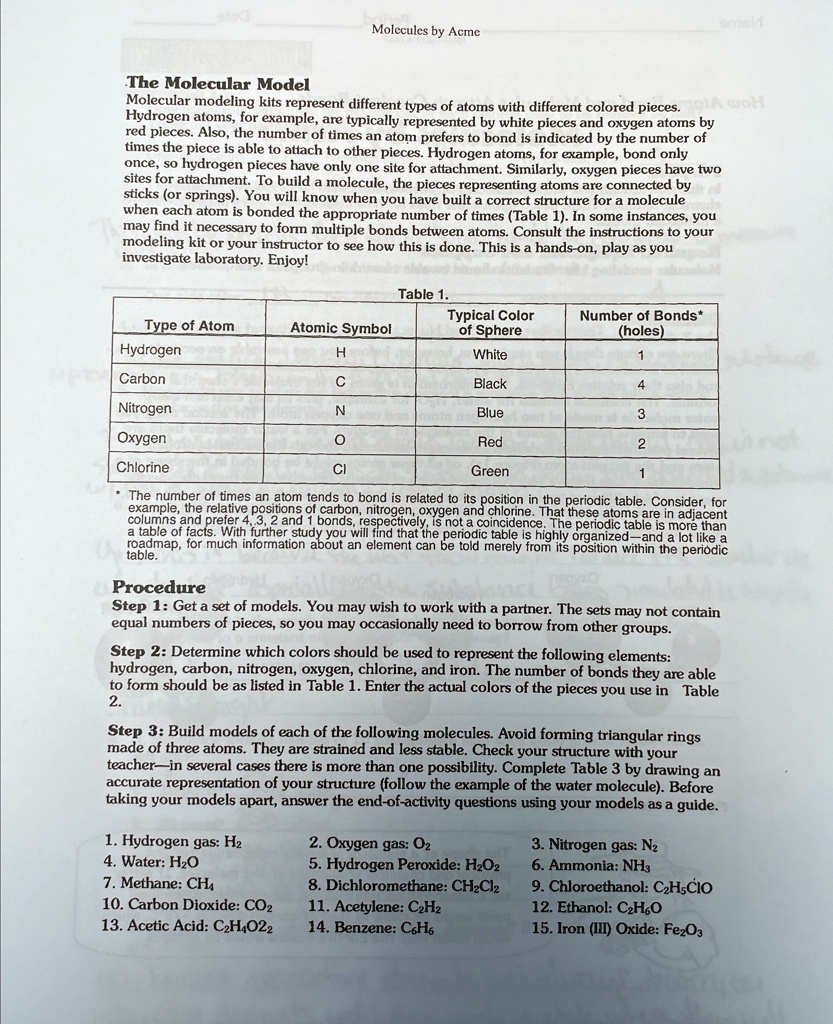
Molecular modeling kits represent different types of atoms with different colored pieces. Hydrogen atoms, for example, are typically represented by white pieces and oxygen atoms by red pieces. Also, the number of times an atom prefers to bond is indicated by the number of times the piece is able to attach to other pieces. Hydrogen atoms, for example, bond only once, so hydrogen pieces have only one site for attachment. Similarly, oxygen pieces have two sites for attachment. To build a molecule, the pieces representing atoms are connected by sticks (or springs). You will know when you have built a correct structure for a molecule when each atom is bonded the appropriate number of times (Table 1). In some instances, you may find it necessary to form multiple bonds between atoms. Consult the instructions to your modeling kit or your instructor to see how this is done. This is a hands-on, play as you investigate laboratory. Enjoy!
able[[Type of Atom,Atomic Symbol, able[[Typical Color],[of Sphere]], able[[Number of Bonds*],[(holes)]]],[Hydrogen,H,White,1],[Carbon,C,Black,4],[Nitrogen,N,Blue,3],[Oxygen,O,Red,2],[Chlorine,Cl,Green,1]]
The number of times an atom tends to bond is related to its position in the periodic table. Consider, for example, the relative positions of carbon, nitrogen, oxygen and chlorine. That these atoms are in adjacent columns and prefer 4,3,2 and 1 bonds, respectively, is not a coincidence. The periodic table is more than a table of facts. With further study you will find that the periodic table is highly organized - and a lot like a roadmap, for much information about an element can be told merely from its position within the periodic table.
Procedure
Step 1: Get a set of models. You may wish to work with a partner. The sets may not contain equal numbers of pieces, so you may occasionally need to borrow from other groups.
Step 2: Determine which colors should be used to represent the following elements: hydrogen, carbon, nitrogen, oxygen, chlorine, and iron. The number of bonds they are able to form should be as listed in Table 1. Enter the actual colors of the pieces you use in Table 2.
Step 3: Build models of each of the following molecules. Avoid forming triangular rings made of three atoms. They are strained and less stable. Check your structure with your teacher - in several cases there is more than one possibility. Complete Table 3 by drawing an accurate representation of your structure (follow the example of the water molecule). Before taking your models apart, answer the end-of-activity questions using your models as a guide.
Hydrogen gas: H_(2)
Water: H_(2)O
Methane: CH_(4)
Carbon Dioxide: CO_(2)
Acetic Acid: C_(2)H_(4)O_(2)
Oxygen gas: O_(2)
Hydrogen Peroxide: H_(2)O_(2)
Dichloromethane: CH_(2)Cl_(2)
Acetylene: C_(2)H_(2)
Benzene: C_(6)H_(6)
Nitrogen gas: N_(2)
Ammonia: NH_(3)
Chloroethanol: C_(2)H_(5)ClO
Ethanol: C_(2)H_(6)O
Iron (III) Oxide: Fe_(2)O_(3)
Molecules by Acme
The Molecular Model Molecular modeling kits represent different types of atoms with different colored pieces. MAoS red pieces. Also, the number of times an atom prefers to bond is indicated by the number of times the piece is able to attach to other pieces. Hydrogen atoms, for example, bond only once, so hydrogen pieces have only one site for attachment. Similarly, oxygen pieces have two
when each atom is bonded the appropriate number of times (Table 1). In some instances, you may find it necessary to form multiple bonds between atoms. Consult the instructions to your modeling kit or your instructor to see how this is done. This is a hands-on, play as you investigate laboratory.Enjoy!
Table 1. Typical Color Atomic Symbol of Sphere H White
Type of Atom Hydrogen Carbon Nitrogen Oxygen Chlorine
Number of Bonds* (holes)
1
C
Black
4
N
Blue
3
Red
2
CI
Green
1
example,the relative positions of carbon,nitrogenoxygen and chlorine.That these atoms are in adjacent
table.
Procedure Step 1: Get a set of models. You may wish to work with a partner. The sets may not contain equal numbers of pieces, so you may occasionally need to borrow from other groups. Step 2: Determine which colors should be used to represent the following elements: hydrogen, carbon, nitrogen, oxygen, chlorine,and iron. The number of bonds they are able to form should be as listed in Table 1.Enter the actual colors of the pieces you use inTable 2. Step 3: Build models of each of the following molecules. Avoid forming triangular rings made of three atoms. They are strained and less stable. Check your structure with your teacher-in several cases there is more than one possibility. Complete Table 3 by drawing an accurate representation of your structure (follow the example of the water molecule. Before taking your models apart, answer the end-of-activity questions using your models as a guide.
1.Hydrogen gas:H2 4.Water:HO 7.Methane:CH4 10.Carbon Dioxide:CO2 13.Acetic Acid:CHO22
2.Oxygen gas:O2 5.Hydrogen Peroxide:HO2 8.Dichloromethane:CHCl2 11.Acetylene:CH2 14.Benzene:CgH
3.Nitrogen gas:Nz 6.Ammonia:NHs 9.Chloroethanol:CHsCIO 12.Ethanol:CHO 15.IronIOxideFeO3