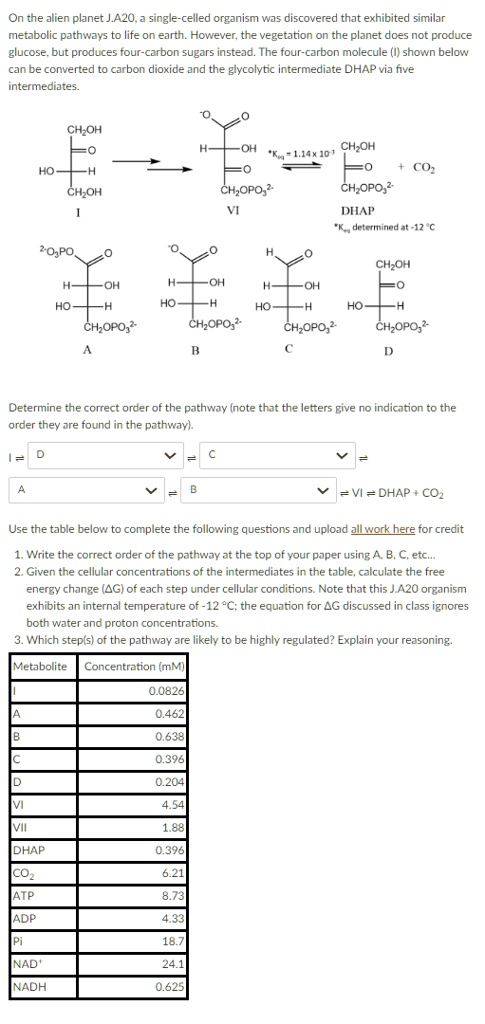
On the alien planet J.A20, a single-celled organism was discovered that exhibited similar
metabolic pathways to life on earth. However, the vegetation on the planet does not produce
glucose, but produces four-carbon sugars instead. The four-carbon molecule (1) shown below
can be converted to carbon dioxide and the glycolytic intermediate DHAP via five
intermediates.
CH₂OH
CH2OH
*K-1.14 x 10³
ヨーヨーヨ
CH2OH
CH2OH
2-O3PO,
HOH
H
H
CH2OPO32-
DHAP
*K determined at -12 °C
CH2OH
毛毛毛毛
H
OH
HO
HO
CH2OPO32-
A
H
HO
CH2OPO32-
B
H
CH2OPO32-
C
HOH
CH₂OPO32-
D
Determine the correct order of the pathway (note that the letters give no indication to the
order they are found in the pathway).
ID
A
B
C
VI DHAP + CO2
Use the table below to complete the following questions and upload all work here for credit
1. Write the correct order of the pathway at the top of your paper using A, B, C, etc...
2. Given the cellular concentrations of the intermediates in the table, calculate the free
energy change (AG) of each step under cellular conditions. Note that this J.A20 organism
exhibits an internal temperature of -12 °C; the equation for AG discussed in class ignores
both water and proton concentrations.
3. Which step(s) of the pathway are likely to be highly regulated? Explain your reasoning.
Metabolite Concentration (mM)
0.0826
0.462
B
0.638
C
0.396
D
0.204
VI
4.54
VII
1.88
DHAP
0.396
CO2
6.21
ATP
8.73
ADP
4.33
Pi
18.7
NAD
24.1
NADH
0.625