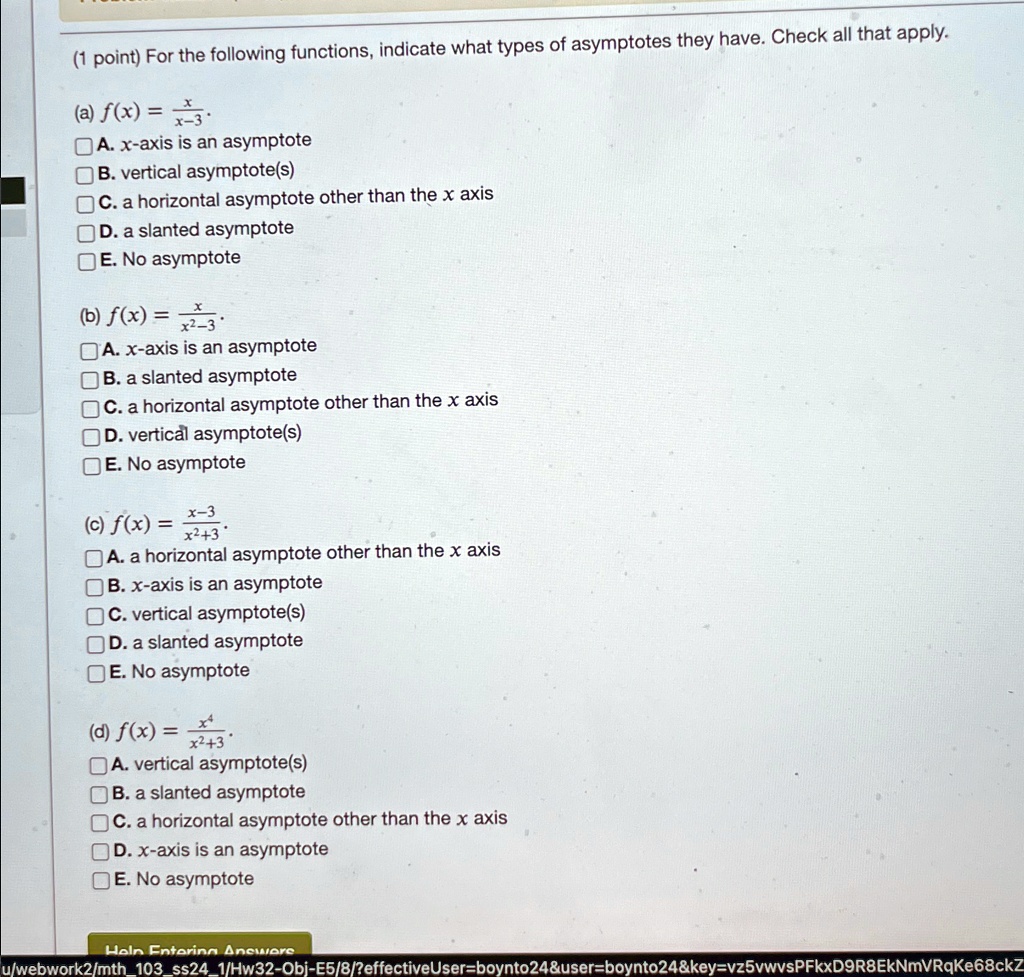
(1 point) For the following functions, indicate what types of asymptotes they have. Check all that apply.
(a) f(x) = (x) / (x - 3).
A. x-axis is an asymptote
B. vertical asymptote(s)
C. a horizontal asymptote other than the x-axis
D. a slanted asymptote
E. No asymptote
(b) f(x) = (x) / (x^2 - 3).
A. x-axis is an asymptote
B. a slanted asymptote
C. a horizontal asymptote other than the x-axis
D. vertical asymptote(s)
E. No asymptote
(c) f(x) = (x - 3) / (x^2 + 3).
A. a horizontal asymptote other than the x-axis
B. x-axis is an asymptote
C. vertical asymptote(s)
D. a slanted asymptote
E. No asymptote
(d) f(x) = (x^4) / (x^2 + 3).
A. vertical asymptote(s)
B. a slanted asymptote
C. a horizontal asymptote other than the x-axis
D. x-axis is an asymptote
E. No asymptote
(1 point) For the following functions, indicate what types of asymptotes they have. Check all that apply.
a) f(x) = -3
A. x-axis is an asymptote
B. vertical asymptote(s)
C. a horizontal asymptote other than the x-axis
D. a slanted asymptote
E. No asymptote
b) f(x) = 2
A. x-axis is an asymptote
B. a slanted asymptote
C. a horizontal asymptote other than the x-axis
D. vertical asymptotes
E. No asymptote
c) f(x) = x - 3 / x^2 + 3
A. a horizontal asymptote other than the x-axis
B. x-axis is an asymptote
C. vertical asymptote(s)
D. a slanted asymptote
E. No asymptote
d) f(x) = x^4
A. vertical asymptote(s)
B. a slanted asymptote
C. a horizontal asymptote other than the x-axis
D. x-axis is an asymptote
E. No asymptote