QUESTION 1
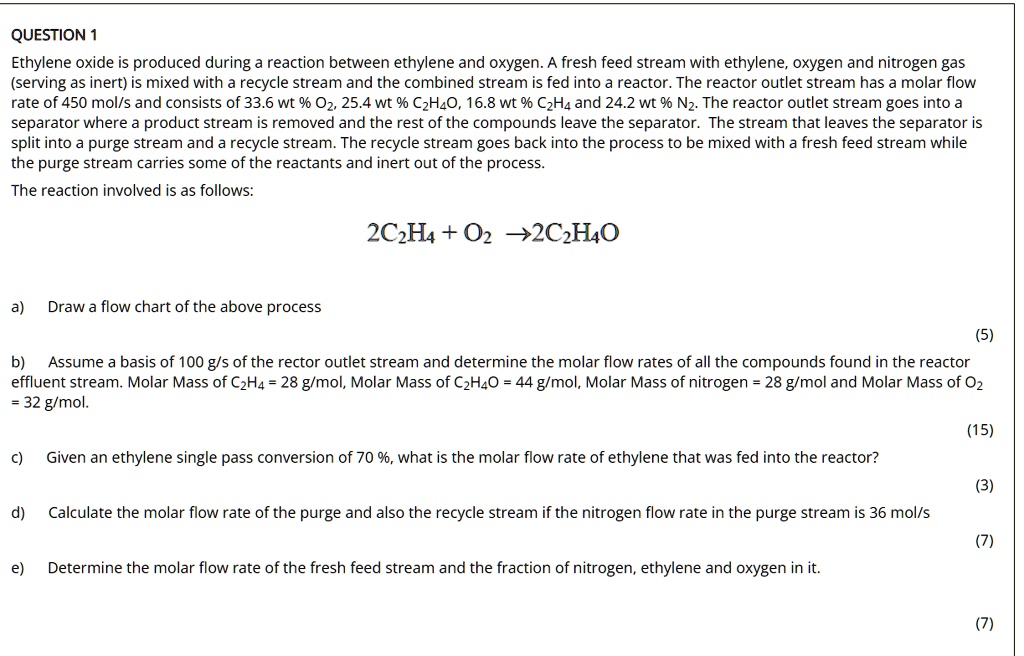
Ethylene oxide is produced during a reaction between ethylene and oxygen. A fresh feed stream with ethylene, oxygen and nitrogen gas
(serving as inert) is mixed with a recycle stream and the combined stream is fed into a reactor. The reactor outlet stream has a molar flow
rate of 450 mol/s and consists of 33.6 wt % O$_2$, 25.4 wt % C$_2$H$_4$O, 16.8 wt % C$_2$H$_4$ and 24.2 wt % N$_2$. The reactor outlet stream goes into a
separator where a product stream is removed and the rest of the compounds leave the separator. The stream that leaves the separator is
split into a purge stream and a recycle stream. The recycle stream goes back into the process to be mixed with a fresh feed stream while
the purge stream carries some of the reactants and inert out of the process.
The reaction involved is as follows:
2C$_2$H$_4$ + O$_2$?2C$_2$H$_4$O
a) Draw a flow chart of the above process
(5)
b) Assume a basis of 100 g/s of the rector outlet stream and determine the molar flow rates of all the compounds found in the reactor
effluent stream. Molar Mass of C$_2$H$_4$ = 28 g/mol, Molar Mass of C$_2$H$_4$O = 44 g/mol, Molar Mass of nitrogen = 28 g/mol and Molar Mass of O$_2$
= 32 g/mol.
(15)
c) Given an ethylene single pass conversion of 70%, what is the molar flow rate of ethylene that was fed into the reactor?
(3)
d) Calculate the molar flow rate of the purge and also the recycle stream if the nitrogen flow rate in the purge stream is 36 mol/s
(7)
e) Determine the molar flow rate of the fresh feed stream and the fraction of nitrogen, ethylene and oxygen in it.
(7)