11-52
Chapter 11: Friction
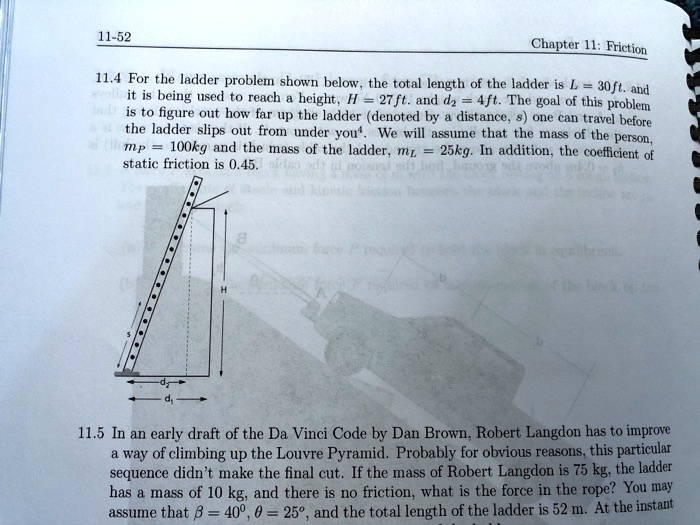
11.4 For the ladder problem shown below, the total length of the ladder is $L = 30\text{ft.}$ and
it is being used to reach a height, $H = 27\text{ft.}$ and $d_2 = 4\text{ft.}$ The goal of this problem
is to figure out how far up the ladder (denoted by a distance, $s$) one can travel before
the ladder slips out from under you. We will assume that the mass of the person,
$m_p = 100\text{kg}$ and the mass of the ladder, $m_l = 25\text{kg}$. In addition, the coefficient of
static friction is 0.45.
H
8
d
d$_1$
11.5 In an early draft of the Da Vinci Code by Dan Brown, Robert Langdon has to improve
a way of climbing up the Louvre Pyramid. Probably for obvious reasons, this particular
sequence didn't make the final cut. If the mass of Robert Langdon is 75 kg, the ladder
has a mass of 10 kg, and there is no friction, what is the force in the rope? You may
assume that $\beta = 40^\circ$, $\theta = 25^\circ$, and the total length of the ladder is 52 m. At the instant