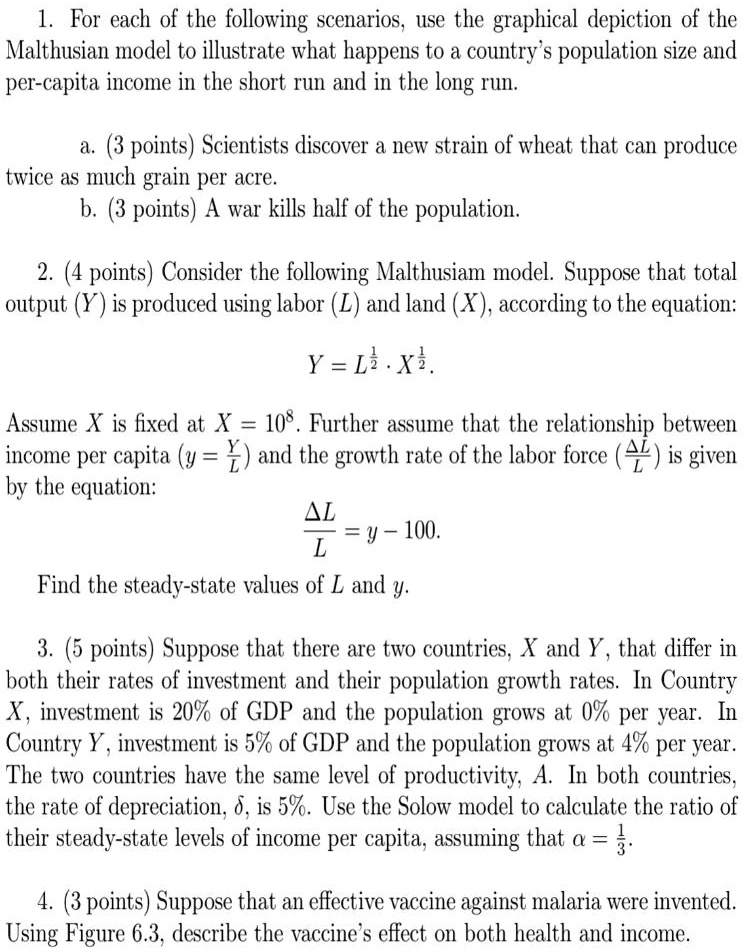
1. For each of the following scenarios, use the graphical depiction of the Malthusian model to illustrate what happens to a country's population size and per capita income in the short run and in the long run.
a. (3 points) Scientists discover a new strain of wheat that can produce twice as much grain per acre. b. (3 points) A war kills half of the population.
2. (4 points) Consider the following Malthusian model. Suppose that total output Y is produced using labor L and land X, according to the equation
Y = L * X
Assume X is fixed at X = 10. Further assume that the relationship between income per capita (y) and the growth rate of the labor force (n) is given by the equation: TL = y - 100. L Find the steady-state values of L and y.
3. (5 points) Suppose that there are two countries, X and Y, that differ in both their rates of investment and their population growth rates. In Country X, investment is 20% of GDP and the population grows at 0% per year. In Country Y, investment is 5% of GDP and the population grows at 4% per year. The two countries have the same level of productivity, A. In both countries, the rate of depreciation is 5%. Use the Solow model to calculate the ratio of capital per worker in Country X to capital per worker in Country Y.
4. (3 points) Suppose that an effective vaccine against malaria were invented. Using Figure 6.3, describe the vaccine's effect on both health and income.