Ace - AI Tutor
Ask Our Educators
Textbooks
My Library
Flashcards
Scribe - AI Notes
Notes & Exams
Download App
Tim Sinyakov

Tim S.

Divider

Questions asked

INSTANT ANSWER

Let n be an integer such that (3n + 6) % 4 = 0. Find (n^2 + 2n + 1) % 4. Justify your claim.

View Answer
divider
INSTANT ANSWER

You want to distribute 20 identical candies amongst 4 of your siblings. (It is possible that after you distribute the candies, one or more of your siblings may not get any candy at all). What is the probability that after the distribution two of your siblings get exactly 3 candies? (a) \( \frac{\left(\begin{array}{c}4 \\ 2\end{array}\right) \cdot\left(\begin{array}{c}15 \\ 1\end{array}\right)}{\left(\begin{array}{c}23 \\ 3\end{array}\right)} \) (c) \( \frac{\left(\begin{array}{c}15 \\ 1\end{array}\right)}{\left(\begin{array}{c}23 \\ 3\end{array}\right)} \) (b) \( \frac{\left(\begin{array}{c}4 \\ 2\end{array}\right)}{\left(\begin{array}{c}20 \\ 4\end{array}\right)} \) (d) \( \frac{20 \cdot 19 \cdot 18 \cdot 17 \cdot 16 \cdot 15}{20^{4}} \)

View Answer
divider
INSTANT ANSWER

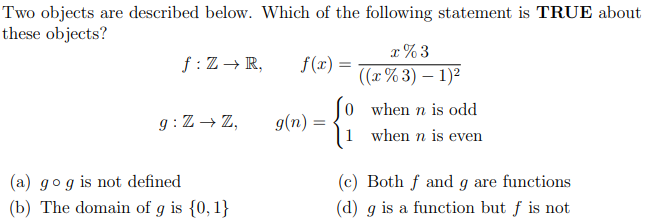
Two objects are described below. Which of the following statement is TRUE about these objects? \[ \begin{array}{c} f: \mathbb{Z} \rightarrow \mathbb{R}, \quad f(x)=\frac{x \% 3}{((x \% 3)-1)^{2}} \\ g: \mathbb{Z} \rightarrow \mathbb{Z}, \quad g(n)=\left\{\begin{array}{ll} 0 & \text { when } n \text { is odd } \\ 1 & \text { when } n \text { is even } \end{array}\right. \end{array} \] (a) \( g \circ g \) is not defined (c) Both \( f \) and \( g \) are functions (b) The domain of \( g \) is \( \{0,1\} \) (d) \( g \) is a function but \( f \) is not
View Answer
divider
INSTANT ANSWER

Consider the functions \( f, g: \mathbb{R} \rightarrow \mathbb{R} \) defined by \[ f(x)=2 x+1 \text { and } g(x)=-x^{2}+6 x-1 . \] Which of the following statements about the function \( g \circ f \) is TRUE? (a) The range of \( g \circ f \) is \( \mathbb{R} \). (b) The range of \( g \circ f \) is equal to the codomain of \( f \). (c) The range of \( g \circ f \) is equal to the range of \( g \). (d) The range of \( g \circ f \) is \( \{x \in \mathbb{R}: x \geq 8\} \).

View Answer
divider
INSTANT ANSWER

Consider the functions \( f, g: \mathbb{R} \rightarrow \mathbb{R} \) defined by \[ f(x)=2 x+1 \text { and } g(x)=-x^{2}+6 x-1 . \] Which of the following statements about the function \( g \circ f \) is TRUE? (a) The range of \( g \circ f \) is \( \mathbb{R} \). (b) The range of \( g \circ f \) is equal to the codomain of \( f \). (c) The range of \( g \circ f \) is equal to the range of \( g \). (d) The range of \( g \circ f \) is \( \{x \in \mathbb{R}: x \geq 8\} \).

View Answer
divider