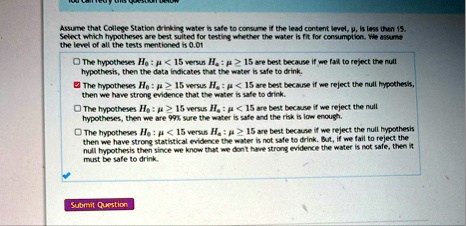
Assume that College Station drinking water is safe to consume if the lead content level, u, is less than 15.
Select which hypotheses are best suited for testing whether the water is fit for consumption. We assume
the level of all the tests mentioned is 0.01
The hypotheses $H_0: \mu < 15$ versus $H_a: \mu \geq 15$ are best because if we fail to reject the null
hypothesis, then the data indicates that the water is safe to drink.
The hypotheses $H_0: \mu \geq 15$ versus $H_a: \mu < 15$ are best because if we reject the null hypothesis,
then we have strong evidence that the water is safe to drink.
The hypotheses $H_0: \mu \geq 15$ versus $H_a: \mu < 15$ are best because if we reject the null
hypotheses, then we are 99% sure the water is safe and the risk is low enough.
The hypotheses $H_0: \mu < 15$ versus $H_a: \mu \geq 15$ are best because if we reject the null hypothesis
then we have strong statistical evidence the water is not safe to drink. But, if we fail to reject the
null hypothesis then since we know that we don't have strong evidence the water is not safe, then it
must be safe to drink.
Submit Question