Texts: Please help, especially part e), f) and g)
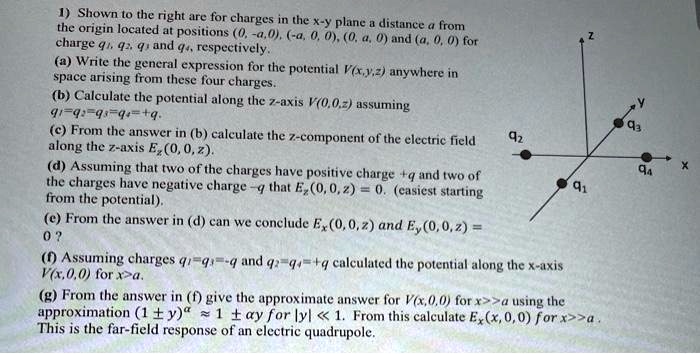
1. Shown to the right are four charges in the x-y plane, a distance "a" from the origin, located at positions (0, -a), (0, a), (-a, 0), and (a, 0) for charges q, q, -q, and -q respectively.
(a) Write the general expression for the potential V(x, y, z) anywhere in space arising from these four charges.
(b) Calculate the potential along the z-axis, V(0, 0, z), assuming q1 = q2 = q3 = q4 = q.
(c) From the answer in (b), calculate the z-component of the electric field E(0, 0, z).
(d) Assuming that two of the charges have positive charge +q and two of the charges have negative charge -q, find the value of z where E(0, 0, z) = 0, starting from the potential.
(e) From the answer in (d), can we conclude that Ex(0, 0, z) and Ey(0, 0, z) are both equal to 0?
(f) Assuming charges q1 = q2 = -q and q3 = q4 = +q, calculate the potential along the x-axis, V(x, 0, 0) for x > a.
(g) From the answer in (f), give the approximate answer for V(x, 0, 0) for x >> a using the approximation 1/(y^2 + a^2) for |y| << 1. From this, calculate Ex(x, 0, 0) for x >> a. This is the far-field response of an electric quadrupole.