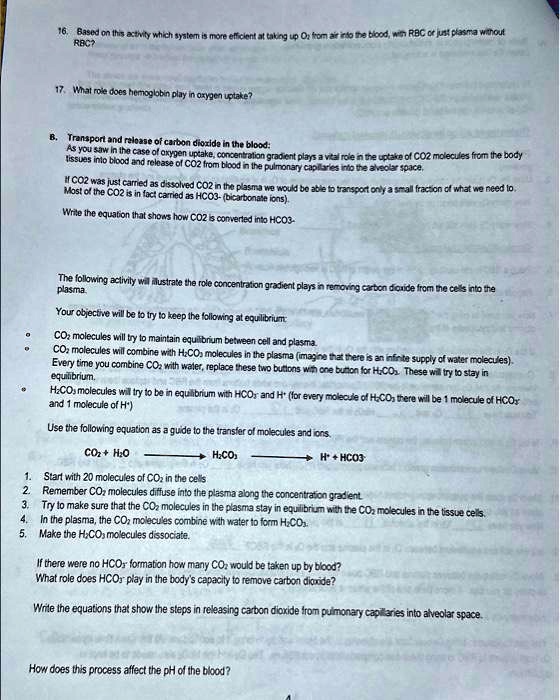
16. Based on this activity, which system is more efficient at taking up O₂ from air into the blood, with RBC or just plasma without RBC?
17. What role does hemoglobin play in oxygen uptake?
B. Transport and release of carbon dioxide in the blood:
As you saw in the case of oxygen uptake, concentration gradient plays a vital role in the uptake of CO2 molecules from the body tissues into blood and release of CO2 from blood in the pulmonary capillaries into the alveolar space. If CO2 was just carried as dissolved CO2 in the plasma, we would be able to transport only a small fraction of what we need to. Most of the CO2 is, in fact, carried as HCO3- (bicarbonate ions). Write the equation that shows how CO2 is converted into HCO3-.
The following activity will illustrate the role concentration gradient plays in removing carbon dioxide from the cells into the plasma. Your objective will be to try to keep the following at equilibrium: CO2 molecules will try to maintain equilibrium between cell and plasma. Net CO2 molecules will combine with H₂CO3 molecules in the plasma (imagine that there is an infinite supply of water molecules). Every time you combine CO2 with water, replace these two buttons with one button for H₂CO3. These will try to stay in equilibrium. Met H₂CO3 molecules will try to be in equilibrium with HCO3 and H+ (for every molecule of H₂CO3, there will be 1 molecule of HCO3- and 1 molecule of H+).
Use the following equation as a guide to the transfer of molecules and ions: CO2 + H2O → H₂CO3.
Start with 20 molecules of CO2 in the cells. Remember, CO2 molecules diffuse into the plasma along the concentration gradient. Try to make sure that the CO2 molecules in the plasma stay in equilibrium with the CO2 molecules in the tissue cells. In the plasma, the CO2 molecules combine with water to form H₂CO3. Make the H₂CO3 molecules dissociate: H+ + HCO3-.
If there were no HCO3- formation, how many CO2 molecules would be taken up by blood? What role does HCO3- play in the body's capacity to remove carbon dioxide? Write the equations that show the steps in releasing carbon dioxide from pulmonary capillaries into the alveolar space. How does this process affect the pH of the blood?