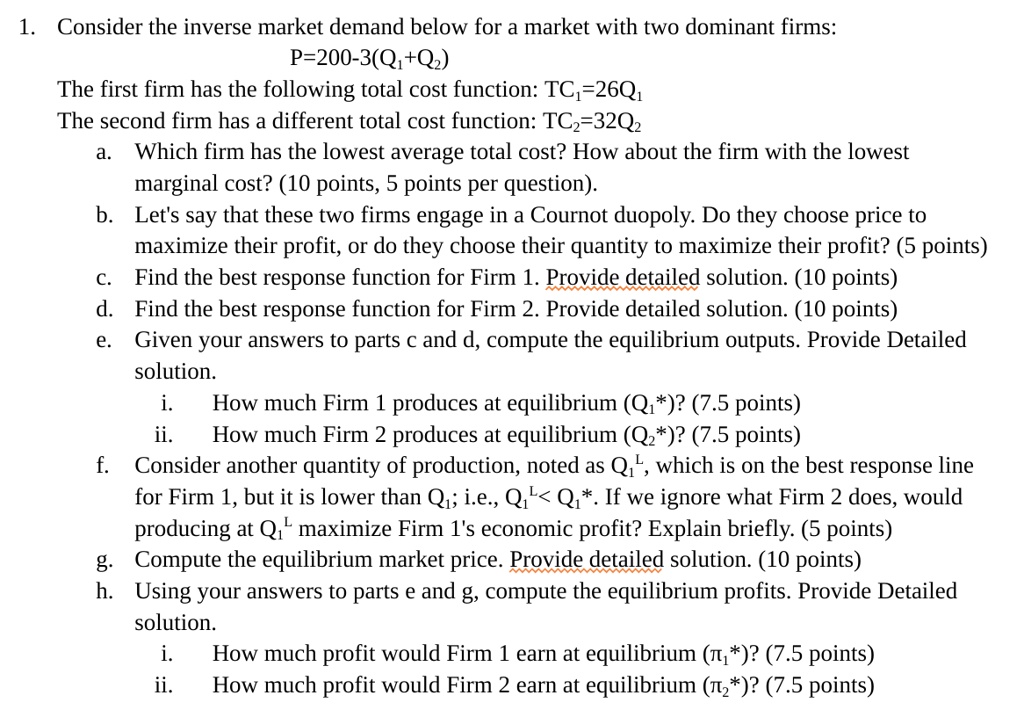
Consider the inverse market demand below for a market with two dominant firms:
P=200-3(Q_(1)+Q_(2))
The first firm has the following total cost function: TC_(1)=26Q_(1)
The second firm has a different total cost function: TC_(2)=32Q_(2)
a. Which firm has the lowest average total cost? How about the firm with the lowest
marginal cost? (10 points, 5 points per question).
b. Let's say that these two firms engage in a Cournot duopoly. Do they choose price to
maximize their profit, or do they choose their quantity to maximize their profit? (5 points)
c. Find the best response function for Firm 1. Provide detailed solution. (10 points)
d. Find the best response function for Firm 2. Provide detailed solution. (10 points)
e. Given your answers to parts c and d, compute the equilibrium outputs. Provide Detailed
solution.
i. How much Firm 1 produces at equilibrium (Q_(1)^(**)) ? (7.5 points)
ii. How much Firm 2 produces at equilibrium (Q_(2)^(**)) ? (7.5 points)
f. Consider another quantity of production, noted as Q_(1)^(L), which is on the best response line
for Firm 1, but it is lower than Q_(1); i.e., Q_(1)^(L)(pi _(1)**)(pi _(2)^(**))Q_(1)^(L). If we ignore what Firm 2 does, would
producing at Q_(1)^(L) maximize Firm 1's economic profit? Explain briefly. (5 points)
g. Compute the equilibrium market price. Provide detailed solution. (10 points)
h. Using your answers to parts e and g, compute the equilibrium profits. Provide Detailed
solution.
i. How much profit would Firm 1 earn at equilibrium (pi _(1)**) ? (7.5 points)
ii. How much profit would Firm 2 earn at equilibrium (pi _(2)^(**)) ? (7.5 points)
1. Consider the inverse market demand below for a market with two dominant firms:
P=200-3(Q+Q2)
The first firm has the following total cost function: TC,=26Q. The second firm has a different total cost function: TC2=32Q a. Which firm has the lowest average total cost? How about the firm with the lowest
marginal cost? (10 points, 5 points per question). b. Let's say that these two firms engage in a Cournot duopoly. Do they choose price to maximize their profit, or do they choose their quantity to maximize their profit? (5 points) C. Find the best response function for Firm 1. Provide detailed solution. (10 points)
d. Find the best response function for Firm 2. Provide detailed solution. (10 points) e. Given your answers to parts c and d, compute the equilibrium outputs. Provide Detailed solution.
i.
How much Firm 1 produces at equilibrium (Qi*)? (7.5 points) How much Firm 2 produces at equilibrium (Q2*)? (7.5 points)
ii.
f.
Consider another quantity of production, noted as Q, which is on the best response line for Firm 1, but it is lower than Qi; i.e., Q< Q*. If we ignore what Firm 2 does, would producing at Qi" maximize Firm 1's economic profit? Explain briefly. (5 points) g. Compute the equilibrium market price. Provide detailed solution. (10 points) h. Using your answers to parts e and g, compute the equilibrium profits. Provide Detailed solution. i. How much profit would Firm 1 earn at equilibrium (n,*)? (7.5 points) ii. How much profit would Firm 2 earn at equilibrium (n2*)? (7.5 points)