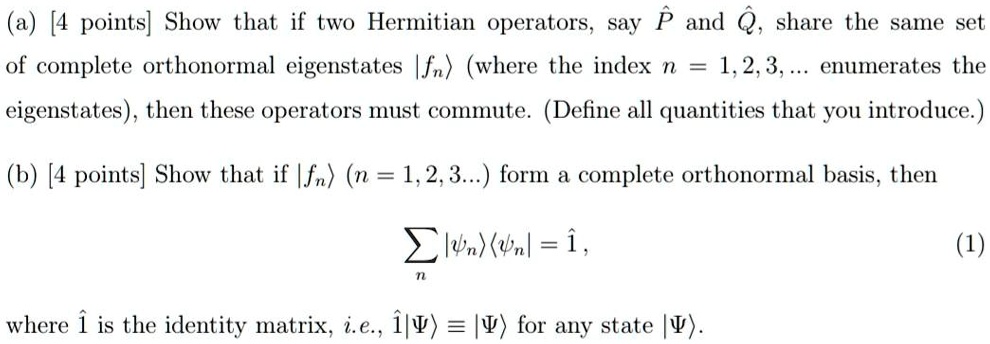
(a) [4 points] Show that if two Hermitian operators, say \hat{P} and \hat{Q}, share the same set of complete orthonormal eigenstates $|f_n\rangle$ (where the index $n = 1, 2, 3,...$ enumerates the eigenstates), then these operators must commute. (Define all quantities that you introduce.)
(b) [4 points] Show that if $|f_n\rangle$ ($n = 1, 2, 3...$) form a complete orthonormal basis, then
$\sum_{n} |\psi_n\rangle \langle \psi_n| = \hat{1}$,
where $\hat{1}$ is the identity matrix, i.e., $\hat{1}|\Psi\rangle = |\Psi\rangle$ for any state $|\Psi\rangle$.