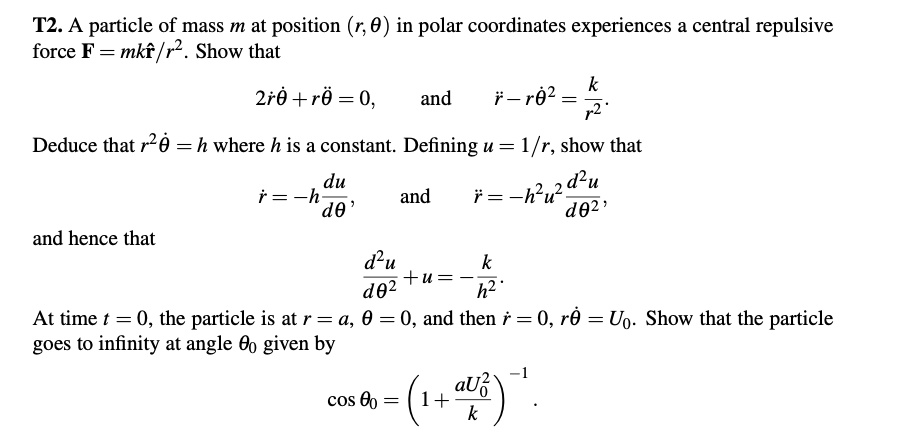
T2. A particle of mass $m$ at position $(r, \theta)$ in polar coordinates experiences a central repulsive force $F = mkf/r^2$. Show that
$2r\dot{\theta} + r\ddot{\theta} = 0$, and $\ddot{r} - r\dot{\theta}^2 = \frac{k}{r^2}$.
Deduce that $r^2\dot{\theta} = h$ where $h$ is a constant. Defining $u = 1/r$, show that
$\dot{r} = -h\frac{du}{d\theta}$, and $\ddot{r} = -h^2u^2\frac{d^2u}{d\theta^2}$,
and hence that
$\frac{d^2u}{d\theta^2} + u = -\frac{k}{h^2}$.
At time $t = 0$, the particle is at $r = a$, $\theta = 0$, and then $\dot{r} = 0$, $r\dot{\theta} = U_0$. Show that the particle goes to infinity at angle $\theta_0$ given by
$\cos \theta_0 = \left(1 + \frac{aU_0^2}{k}\right)^{-1}$.