Polar covalent bond
Nonpolar covalent bond
Nonpolar covalent bond
Solvent
1
A polar or ionic compound that interacts with water
The degree to which a solute will dissolve in a solvent
A nonpolar compound or molecule that does not interact with water
A substance present in a solution in lower amounts; often a solid
A process during which chemical bonds are broken, formed, or rearranged, or electrons are exchanged between reactants
A nonpolar covalent bond results from the equal sharing of electrons, and thus the resulting molecule does not have partial positive or negative ends
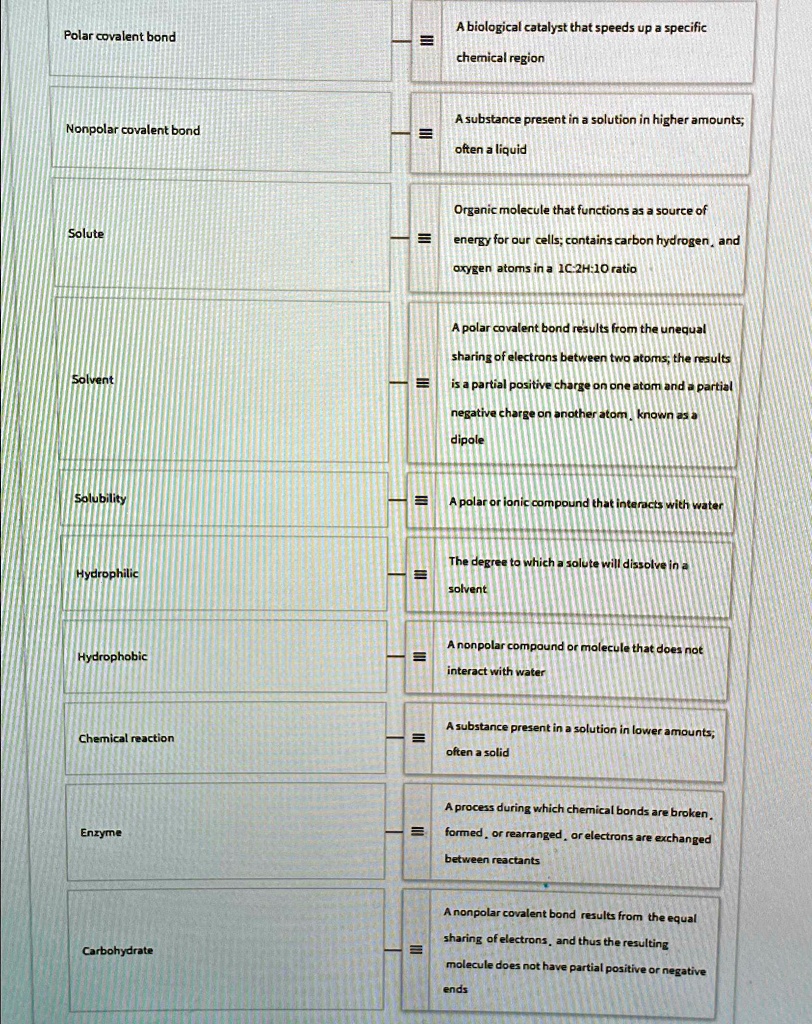
Polar covalent bond
A biological catalyst that speeds up a specific chemical reaction
Nonpolar covalent bond
A substance present in a solution in higher amounts; often a liquid
Organic molecule that functions as a source of energy for our cells; contains carbon, hydrogen, and oxygen atoms in a 1C2H10 ratio
A polar covalent bond results from the unequal sharing of electrons between two atoms; the result is a partial positive charge on one atom and a partial negative charge on another atom known as a dipole
Solvent
Solubility
A polar or ionic compound that interacts with water
The degree to which a solute will dissolve in a solvent
Hydrophilic
A nonpolar compound or molecule that does not interact with water
Hydrophobic
A substance present in a solution in lower amounts; often a solid
Chemical reaction
A process during which chemical bonds are broken, formed, or rearranged, or electrons are exchanged between reactants
Enzyme
A nonpolar covalent bond results from the equal sharing of electrons, and thus the resulting molecule does not have partial positive or negative ends
Carbohydrate