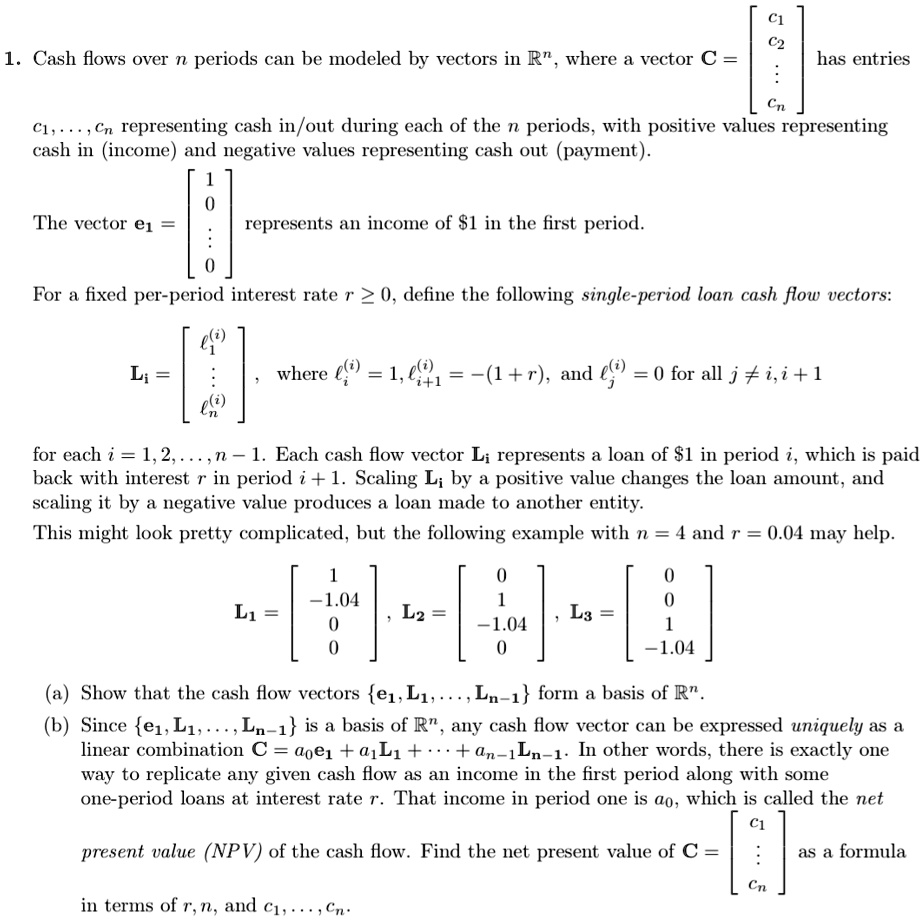
1. Cash flows over $n$ periods can be modeled by vectors in $\mathbb{R}^n$, where a vector $C = \begin{bmatrix} C_1 \\ C_2 \\ \vdots \\ C_n \end{bmatrix}$ has entries $C_1,...,C_n$ representing cash in/out during each of the $n$ periods, with positive values representing cash in (income) and negative values representing cash out (payment).
The vector $e_1 = \begin{bmatrix} 1 \\ 0 \\ \vdots \\ 0 \end{bmatrix}$ represents an income of $1 in the first period.
For a fixed per-period interest rate $r \ge 0$, define the following single-period loan cash flow vectors:
$L_i = \begin{bmatrix} l_1^{(i)} \\ \vdots \\ l_n^{(i)} \end{bmatrix}$, where $l_i^{(i)} = 1, l_{i+1}^{(i)} = -(1+r)$, and $l_j^{(i)} = 0$ for all $j \neq i, i+1$
for each $i = 1,2,...,n-1$. Each cash flow vector $L_i$ represents a loan of $1 in period $i$, which is paid back with interest $r$ in period $i+1$. Scaling $L_i$ by a positive value changes the loan amount, and scaling it by a negative value produces a loan made to another entity.
This might look pretty complicated, but the following example with $n = 4$ and $r = 0.04$ may help.
$L_1 = \begin{bmatrix} 1 \\ -1.04 \\ 0 \\ 0 \end{bmatrix}$, $L_2 = \begin{bmatrix} 0 \\ 1 \\ -1.04 \\ 0 \end{bmatrix}$, $L_3 = \begin{bmatrix} 0 \\ 0 \\ 1 \\ -1.04 \end{bmatrix}$
(a) Show that the cash flow vectors {$e_1, L_1,...,L_{n-1}$} form a basis of $\mathbb{R}^n$.
(b) Since {$e_1, L_1,...,L_{n-1}$} is a basis of $\mathbb{R}^n$, any cash flow vector can be expressed uniquely as a linear combination $C = a_0e_1 + a_1L_1 + ... + a_{n-1}L_{n-1}$. In other words, there is exactly one way to replicate any given cash flow as an income in the first period along with some one-period loans at interest rate $r$. That income in period one is $a_0$, which is called the net present value (NPV) of the cash flow. Find the net present value of $C = \begin{bmatrix} C_1 \\ \vdots \\ C_n \end{bmatrix}$ as a formula in terms of $r$, $n$, and $C_1,...,C_n$.