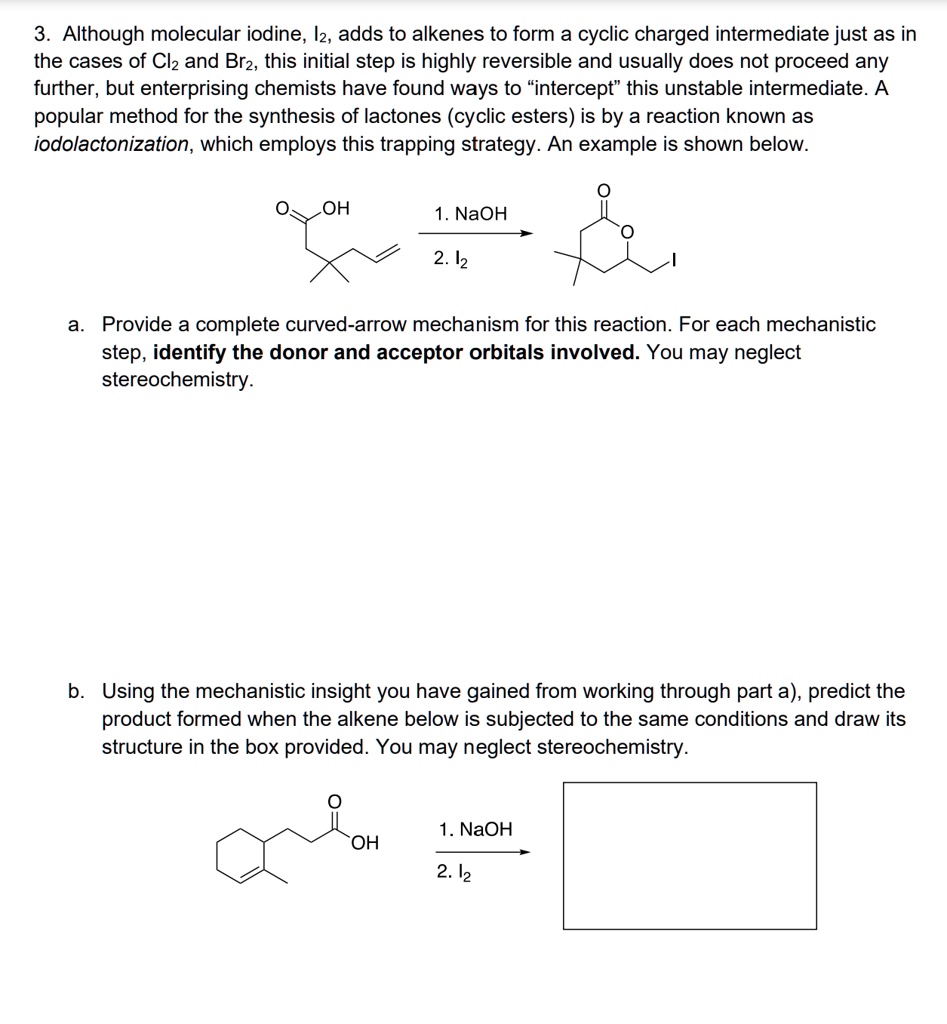
Although molecular iodine, I_(2), adds to alkenes to form a cyclic charged intermediate just as in the cases of Cl_(2) and Br_(2), this initial step is highly reversible and usually does not proceed any further, but enterprising chemists have found ways to "intercept" this unstable intermediate. A popular method for the synthesis of lactones (cyclic esters) is by a reaction known as iodolactonization, which employs this trapping strategy. An example is shown below.
a. Provide a complete curved-arrow mechanism for this reaction. For each mechanistic step, identify the donor and acceptor orbitals involved. You may neglect stereochemistry.
b. Using the mechanistic insight you have gained from working through part a), predict theproduct formed when the alkene below is subjected to the same conditions and draw its structure in the box provided. You may neglect stereochemistry.
3. Although molecular iodine, l2, adds to alkenes to form a cyclic charged intermediate just as in the cases of Cl2 and Br2, this initial step is highly reversible and usually does not proceed any further, but enterprising chemists have found ways to "intercept" this unstable intermediate. A popular method for the synthesis of lactones (cyclic esters) is by a reaction known as iodolactonization, which employs this trapping strategy. An example is shown below.
1.NaOH
a. Provide a complete curved-arrow mechanism for this reaction. For each mechanistic step, identify the donor and acceptor orbitals involved. You may neglect stereochemistry.
b. Using the mechanistic insight you have gained from working through part a), predict the
structure in the box provided. You may neglect stereochemistry
1.NaOH
OH
2.12