Ace - AI Tutor
Ask Our Educators
Textbooks
My Library
Flashcards
Scribe - AI Notes
Notes & Exams
Download App
timothy weaver

timothy w.

Divider

Questions asked

BEST MATCH

A landowner chooses not to irrigate his property and some of the trees on his property die. Suppose the economic value of the dead trees is $400. The external costs of the landowner's choice not to irrigate are Part 2 A. more than $400, because there is value associated with the trees above their economic value. B. $400. C. zero, because the landowner bears all the costs. D. zero, because the value of the trees is irrelevant.

View Answer
divider
BEST MATCH

When 1 mole of reacts with to form according to the following equation, 92.2 kJ of energy are evolved N2(g)+3H2(g)>2NH3(g) Is this reaction endothermic or exothermic?

View Answer
divider
BEST MATCH

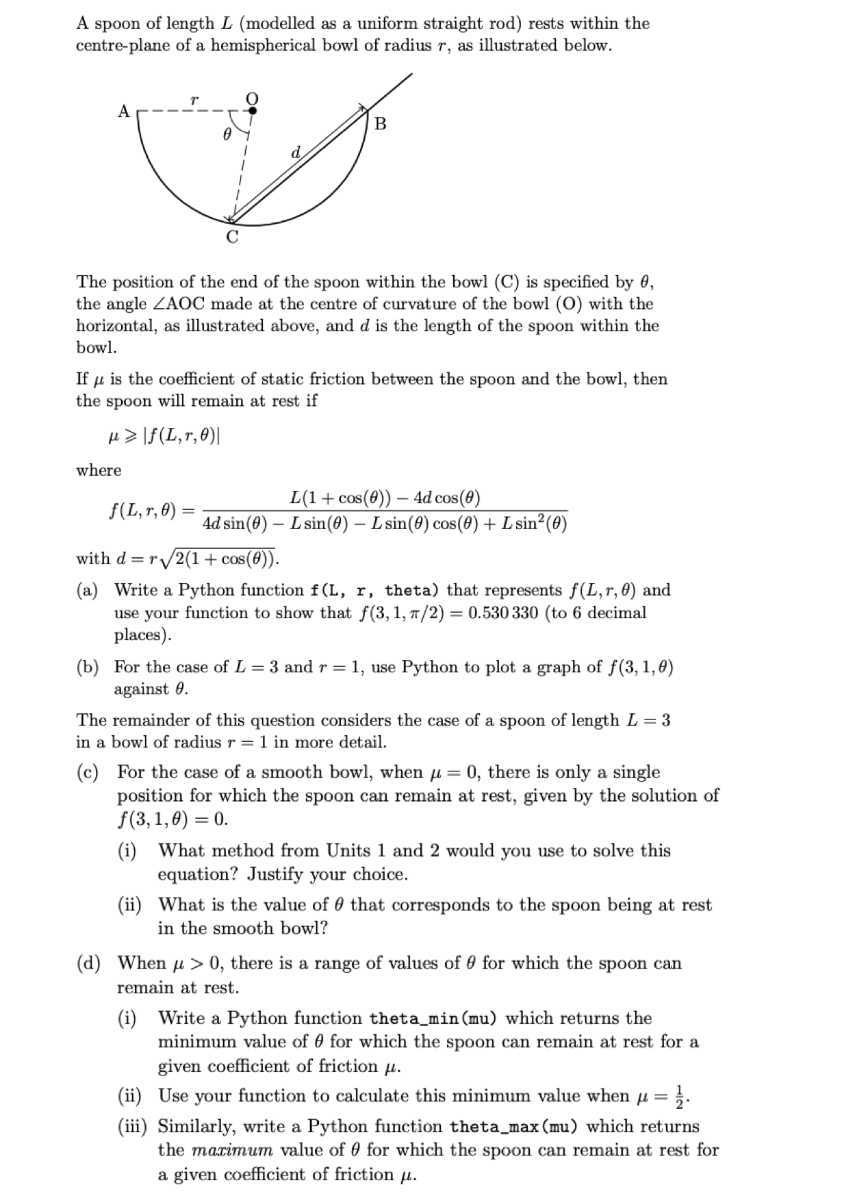
A spoon of length \( L \) (modelled as a uniform straight rod) rests within the centre-plane of a hemispherical bowl of radius \( r \), as illustrated below. The position of the end of the spoon within the bowl (C) is specified by \( \theta \), the angle \( \angle A O C \) made at the centre of curvature of the bowl ( O ) with the horizontal, as illustrated above, and \( d \) is the length of the spoon within the bowl. If \( \mu \) is the coefficient of static friction between the spoon and the bowl, then the spoon will remain at rest if \[ \mu \geqslant|f(L, r, \theta)| \] where \[ f(L, r, \theta)=\frac{L(1+\cos (\theta))-4 d \cos (\theta)}{4 d \sin (\theta)-L \sin (\theta)-L \sin (\theta) \cos (\theta)+L \sin ^{2}(\theta)} \] with \( d=r \sqrt{2(1+\cos (\theta))} \). (a) Write a Python function \( \mathrm{f}(\mathrm{L}, \mathrm{r} \), theta) that represents \( f(L, r, \theta) \) and use your function to show that \( f(3,1, \pi / 2)=0.530330 \) (to 6 decimal places). (b) For the case of \( L=3 \) and \( r=1 \), use Python to plot a graph of \( f(3,1, \theta) \) against \( \theta \). The remainder of this question considers the case of a spoon of length \( L=3 \) in a bowl of radius \( r=1 \) in more detail. (c) For the case of a smooth bowl, when \( \mu=0 \), there is only a single position for which the spoon can remain at rest, given by the solution of \( f(3,1, \theta)=0 \). (i) What method from Units 1 and 2 would you use to solve this equation? Justify your choice. (ii) What is the value of \( \theta \) that corresponds to the spoon being at rest in the smooth bowl? (d) When \( \mu>0 \), there is a range of values of \( \theta \) for which the spoon can remain at rest. (i) Write a Python function theta_min(mu) which returns the minimum value of \( \theta \) for which the spoon can remain at rest for a given coefficient of friction \( \mu \). (ii) Use your function to calculate this minimum value when \( \mu=\frac{1}{2} \). (iii) Similarly, write a Python function theta_max (mu) which returns the maximum value of \( \theta \) for which the spoon can remain at rest for a given coefficient of friction \( \mu \).
View Answer
divider
BEST MATCH

Find the volume $V$ of the solid obtained by rotating the region bounded by the given curves about the specified line. $y^2 = 2x$, $x = 2y$; about the $y$-axis $V = \frac{512\pi}{15}$ Sketch the region.

View Answer
divider
BEST MATCH

3. Only 0.0020 M HAc was initially put into each solution in Table 1. So why does [HAc] have the value it has at pH 3.00? Where does the additional HAc come from? 4. Only 0.001 M NaAc was put into each solution initially. Does the value of [Ac-] at pH 7.00 make sense compared to the other values in Table 1? Be prepared to explain your reasoning. 5. Divide up the blanks in Table 1 and use the $K$ expression for the acetic acid equilibrium or the Henderson-Hasselbalch equation, as you prefer, to calculate the appropriate quantity. The $pK_a$ for acetic acid is 4.76. Do the concentrations you get seem to make sense?

View Answer
divider
BEST MATCH

Solve the following exponential equation. Express irrational solutions in exact form and as a decimal rounded to three decimal place \pi^{1-5x} = e^{9x} What is the exact answer? Select the correct choice below and, if necessary, fill in the answer box to complete your choice. A. The solution set is (Simplify your answer. Type an exact answer.) B. There is no solution.

View Answer
divider
BEST MATCH

Given the following voltage and current v(t) = 29cos(377t + 110°) i(t) = 2cos(377t - 13°) The value of the current at t = 1msec is: A. 2.00 B. 1.98

View Answer
divider
BEST MATCH

Part 3) Matlab Simulation 3-1) DFT/FFT Use DFT (implemented by the FFT algorithm) to compute the Fourier transform of e^(-2t). Plot the resulting Fourier spectra. We first determine T and To. The Fourier transform of e^(-2t) is 1/(j+2). This low-pass signal is not band-limited. Let us take its essential bandwidth to be that frequency where |G| becomes 1% of its peak value, which occurs at ω=0. Observe that 1/(1+|G|^2) = 2/(2+4). Also, the peak of |G| is at ω=0, where |G(0)|=0.5. Hence, the essential bandwidth B is at ω=2B, where 1/(1+|G|^2) = 0.50.01/(2πB) Hz. From Eq.3.104b, 1/(2πB) = 0.005 = 0.0157. Let us round this value down to T = 0.015625 second so that we have 64 samples per second. The second issue is to determine To. The signal is not time-limited. We need to truncate it at To such that g(To) = 1. We shall pick To = 4 (eight time constants of the signal), which yields No = To/T = 256. This is a power of 2. Note that there is a great deal of flexibility in determining Ts and To, depending on the accuracy desired and the computational capacity available. We could just as well have picked To = 8 and T = 1/32, yielding No = 256, although this would have given a slightly higher aliasing error. Because the signal has a jump discontinuity at t = 0, the first sample at t = 0 is 0.5, the average of the values on the two sides of the discontinuity. The MATLAB program, which implements the DFT using the FFT algorithm, is as follows: Ts = 1/64; To = 4; No = To/Ts; t = 0:Ts:Ts*(No-1); t = t; g = Ts*exp(-2*t); g1 = Ts*0.5; G = fft(g); [Gp, Gm] = cart2pol(real(G), imag(G)); k = 0:No-1; k = k; w = 2*pi*k/To; subplot(2,1,1); stem(w(1:32), Gm(1:32)); subplot(2,1,2); stem(w(1:32), Gp(1:32)); Plot the Fourier transform and explain the result.

View Answer
divider
BEST MATCH

QUESTION 2 All the muscles that extend the hip are located on: the front of the hip. the back of the hip. the lateral side of the hip. The inside of the hip.

View Answer
divider
BEST MATCH

Determine the fundamental range frequency $\Omega_f$ for the sinusoids of the frequencies \newline $\Omega = (a) 0.8\pi$ (b) $1.2\pi$ (c) 6.9 (d) $3.7\pi$ (e) $22.9\pi$. For each case, determine also the \newline lowest frequency which can be used to describe these sinusoids.

View Answer
divider