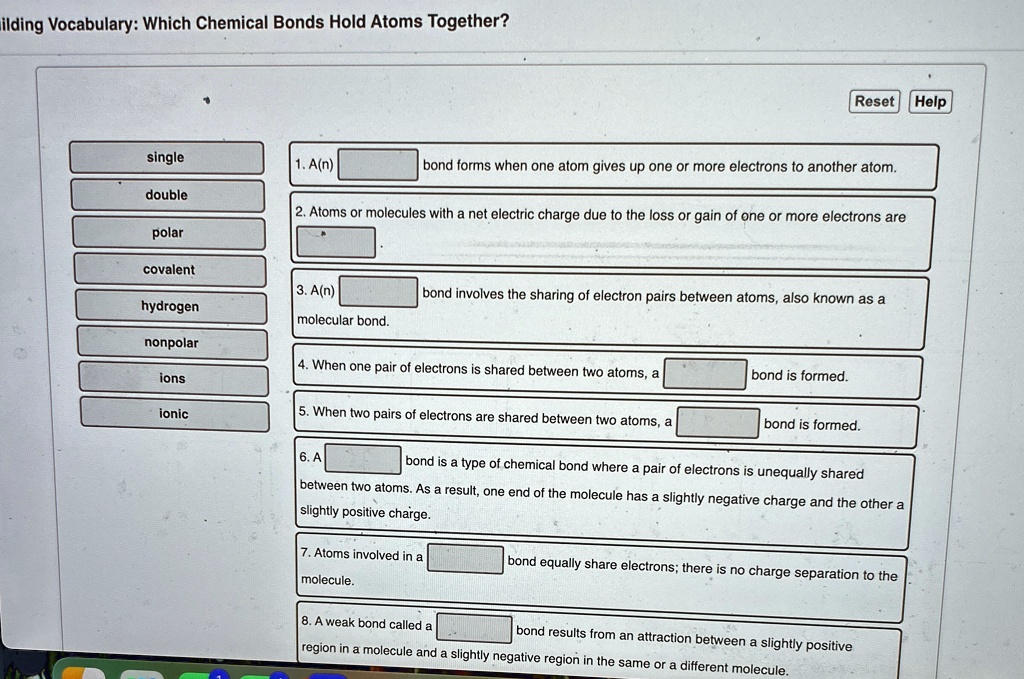
1. A(n) $\boxed{ionic}$ bond forms when one atom gives up one or more electrons to another atom.
2. Atoms or molecules with a net electric charge due to the loss or gain of one or more electrons are $\boxed{ions}$.
3. A(n) $\boxed{covalent}$ bond involves the sharing of electron pairs between atoms, also known as a $\boxed{molecular}$ bond.
4. When one pair of electrons is shared between two atoms, a $\boxed{single}$ bond is formed.
5. When two pairs of electrons are shared between two atoms, a $\boxed{double}$ bond is formed.
6. A $\boxed{polar}$ bond is a type of chemical bond where a pair of electrons is unequally shared between two atoms. As a result, one end of the molecule has a slightly negative charge and the other a slightly positive charge.
7. Atoms involved in a $\boxed{nonpolar}$ bond equally share electrons; there is no charge separation to the molecule.
8. A weak bond called a $\boxed{hydrogen}$ bond results from an attraction between a slightly positive region in a molecule and a slightly negative region in the same or a different molecule.