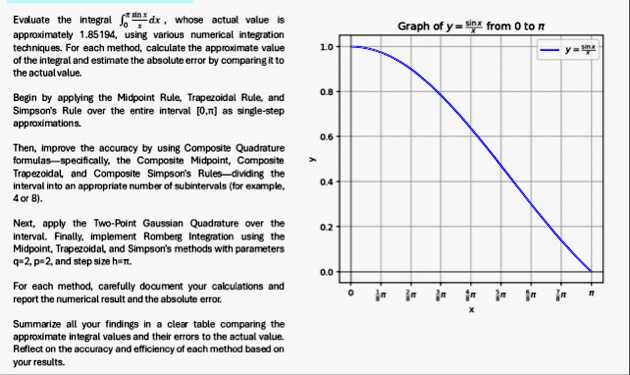
Graph of $y = \frac{\sin x}{x}$ from $0$ to $\pi$
$1.0$
$y$
$0.8$
$0.6$
$0.4$
$0.2$
$0.0$
$0$
$\frac{1}{8}\pi$
$\frac{2}{8}\pi$
$\frac{3}{8}\pi$
$\frac{4}{8}\pi$
$\frac{5}{8}\pi$
$\frac{6}{8}\pi$
$\frac{7}{8}\pi$
$\pi$
$x$
$y = \frac{\sin x}{x}$
Evaluate the integral $\int_{0}^{\pi} \frac{\sin x}{x} dx$, whose actual value is approximately $1.85194$, using various numerical integration techniques. For each method, calculate the approximate value of the integral and estimate the absolute error by comparing it to the actual value.
Begin by applying the Midpoint Rule, Trapezoidal Rule, and Simpson's Rule over the entire interval $[0, \pi]$ as single-step approximations.
Then, improve the accuracy by using Composite Quadrature formulas—specifically, the Composite Midpoint, Composite Trapezoidal, and Composite Simpson's Rules—dividing the interval into an appropriate number of subintervals (for example, $4$ or $8$).
Next, apply the Two-Point Gaussian Quadrature over the interval. Finally, implement Romberg Integration using the Midpoint, Trapezoidal, and Simpson's methods with parameters $q=2$, $p=2$, and step size $h=\pi$.
For each method, carefully document your calculations and report the numerical result and the absolute error.
Summarize all your findings in a clear table comparing the approximate integral values and their errors to the actual value. Reflect on the accuracy and efficiency of each method based on your results.