Ace - AI Tutor
Ask Our Educators
Textbooks
My Library
Flashcards
Scribe - AI Notes
Notes & Exams
Download App
tina priego

tina p.

Divider

Questions asked

BEST MATCH

A device to scar, burn, or cut a tissue is termed: O bolus. O cannula. O cautery. O respirator.

View Answer
divider
BEST MATCH

A sample of 26 research participants has a mean of 54, while the population mean is 50. The sum of squares of the sample scores is 400. What is Cohen's d for this sample?

View Answer
divider
BEST MATCH

What are the two nerves associated with the autonomic nervous system?

View Answer
divider
BEST MATCH

According to the marginal productivity theory of income, at the equilibrium, __________. Group of answer choices all workers are paid less than the value of the output generated by the last worker. the first worker is paid more than the value of the output generated by the first worker. each worker is paid the value of the output generated by the last worker. each worker is paid the value of the output generated by each worker.

View Answer
divider
BEST MATCH

meant by the somatic and autonomic nervous systems. 2. Explain why receptors respond to specific stimuli, and how the organization of a receptor affects its sensitivity with respect to its receptive field. Define adaptation and explain how it differs in tonic versus phasic receptors. Distinguish the special senses from the general senses, and sensation from perception.

View Answer
divider
BEST MATCH

c) Calculate the text statistic and p-value associated with the test statistic. Value of Test Statistic: p-value d) Based on your test statistic, should you reject or fail to reject the null hypothesis? Summarize your findings based on the claim being made. e) Construct a 98% confidence interval for the number of times a coin lands on tails.

View Answer
divider
BEST MATCH

Use the graph at the right to find the following limits. a. $\lim_{x \to \infty} f(x)$ b. $\lim_{x \to 2} f(x)$ c. $\lim_{x \to -3^+} f(x)$ Write your answer in the form: a. ______ b. ______ c. ______

View Answer
divider
BEST MATCH

Q1) 12V W I? I? R? 20V R? W I? 12V R? = 4 ohm R? = 8 ohm R? = 8 ohm i) Find the currents $I_1$, $I_2$ and $I_3$ passing through the respective resistors; $R_1$, $R_2$ and $R_3$ ii) What is the potential drop (voltage) across $R_3$. iii) What is the power dissipated in $R_3$? iv) What is the total power output of the 20V battery? Note: Must draw diagram showing assumed current directions and loop orientations

View Answer
divider
BEST MATCH

R2 10k + V1 + R3 6k 6 R1 20k I_test vtest V2 + 24 V Figure 1 1. Find the Thevenin equivalent circuit (that is, find $V_{OC}$ and $R_{TH}$) of the network in the dotted box in Figure 1 using hand calculations.

View Answer
divider
BEST MATCH

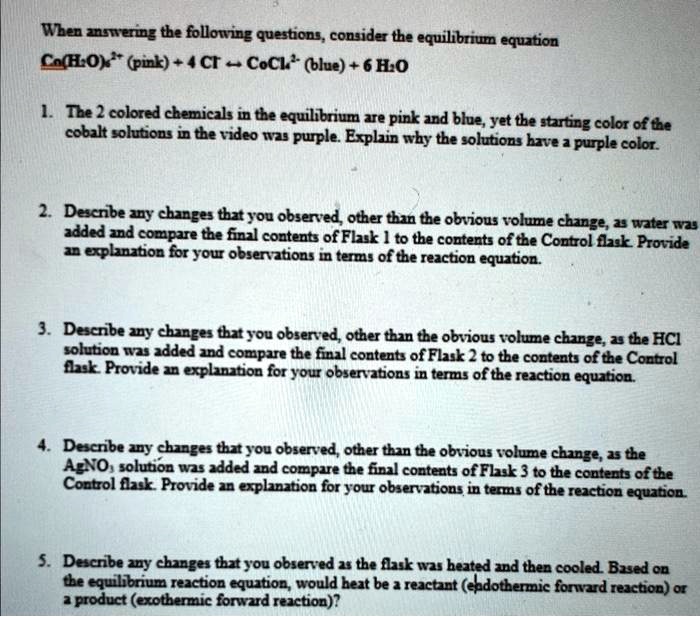
When answering the following questions, consider the equilibrium equation Co(H$_2$O)$_6^{2+}$ (pink) + 4 Cl$^-$ <=> CoCl$_4^{2-}$ (blue) + 6 H$_2$O 1. The 2 colored chemicals in the equilibrium are pink and blue, yet the starting color of the cobalt solutions in the video was purple. Explain why the solutions have a purple color. 2. Describe any changes that you observed, other than the obvious volume change, as water was added and compare the final contents of Flask 1 to the contents of the Control flask. Provide an explanation for your observations in terms of the reaction equation. 3. Describe any changes that you observed, other than the obvious volume change, as the HCl solution was added and compare the final contents of Flask 2 to the contents of the Control flask. Provide an explanation for your observations in terms of the reaction equation. 4. Describe any changes that you observed, other than the obvious volume change, as the AgNO$_3$ solution was added and compare the final contents of Flask 3 to the contents of the Control flask. Provide an explanation for your observations in terms of the reaction equation. 5. Describe any changes that you observed as the flask was heated and then cooled. Based on the equilibrium reaction equation, would heat be a reactant (endothermic forward reaction) or a product (exothermic forward reaction)?
View Answer
divider