Ace - AI Tutor
Ask Our Educators
Textbooks
My Library
Flashcards
Scribe - AI Notes
Notes & Exams
Download App
todd johnson

todd j.

Divider

Questions asked

BEST MATCH

24. How did wind-generated resonance affect the Tacoma Narrows Bridge in Washington in 1940?

View Answer
divider
BEST MATCH

Complete the code to generate the following boxplot. Sleep Impact -1 0 1 2 3 4 5 1 2 Drug Used [Select] [Select] ( , col = c('skyblue2', 'plum'), xlab = "Drug Used", names = c("1", "2"), ylab = "Sleep Impact")

View Answer
divider
BEST MATCH

Brayson's son was diagnosed with having a chromosomal abnormality. If you were Brayson's friend, how would you explain the cause of chromosomal abnormalities? a) a zygote that fails to separate completely b) two eggs being fertilized by two sperm c) inheriting the wrong type of chromosomes d) inheriting too many or too few chromosomes

View Answer
divider
BEST MATCH

Problem 1. Show that A is diagonalizable. Then find $A^{2012}$. $A = \begin{pmatrix} 4 & 2 & 2 \\ 2 & 1 & 1 \\ -8 & -4 & -4 \end{pmatrix}$

View Answer
divider
BEST MATCH

Assume that you were born sex-typed 'XX'. However, by the age of 13, you were feeling more masculine than feminine. By the time you started high school, you were presenting yourself as male. Discuss some biological and social factors that influence this transgendering process. What forms of sexual discrimination and inequality are you experiencing at school and work? How might you overcome sex inequality? Biological Influences: Social Influences: Forms of social inequality at school: Forms of social inequality at work: Overcoming sexual inequality:

View Answer
divider
BEST MATCH

dog, Rocky. Nathan has now become terrified of going to his Grandma's home and he screams louder when he gets closer to her front door. Which of the following is true ? The CR = getting knocked down The CS = screaming The UCS = the front door The UCR = feeling terrified

View Answer
divider
BEST MATCH

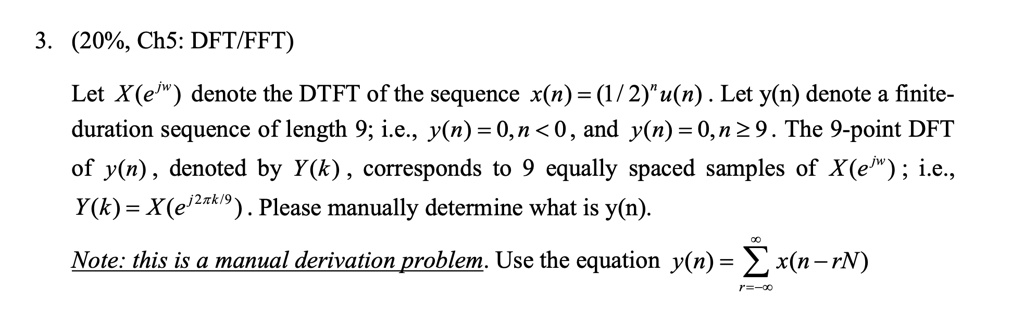
3. (20%, Ch5: DFT/FFT) Let $X(e^{jw})$ denote the DTFT of the sequence $x(n) = (1/2)^n u(n)$. Let $y(n)$ denote a finite- duration sequence of length 9; i.e., $y(n) = 0, n < 0$, and $y(n) = 0, n \ge 9$. The 9-point DFT of $y(n)$, denoted by $Y(k)$, corresponds to 9 equally spaced samples of $X(e^{jw})$; i.e., $Y(k) = X(e^{j2\pi k/9})$. Please manually determine what is $y(n)$. Note: this is a manual derivation problem. Use the equation $y(n) = \sum_{r=-\infty}^{\infty} x(n - rN)$
View Answer
divider
BEST MATCH

In Hyperabrupt junctions (m<0), how can we derive the equation (5.72)? 5.7 Nonuniformly Doped pn Junctions x=0 31 n-type doping profiles +1 Bxg m=0 x=0 xo Figure 5.28: Generalized doping profiles of a one-sided pn junction. From Sze[15]. The generalized n-type doping concentration for x > 0 is given by N = Bx^m (5.71). The case of m=0 corresponds to the uniformly doped junction, and m+1 corresponds to the linearly graded junction just discussed. The cases of m=+2 and m=+3 shown would approximate a fairly low-doped epitaxial n-type layer grown before. The equation for the hyperabrupt junction at x=0 when m is negative is given by e^(B(m+1)C+1)/(1+m+2Vbi+VR) (5.72).

View Answer
divider
BEST MATCH

(b) A linear time-invariant (LTI) system is shown in Figure Q1. A signal $x(t) = rect(t)$ is applied at the input of an ideal low pass filter with frequency response $H_1(\omega) =$ $rect(\omega/4\pi)$. The filtered signal of $Y(\omega)$ is shown. (i) Illustrate graphically $X(\omega)$, $H_1(\omega)$, $E(\omega)$ and $F(\omega)$. (7 marks) (ii) Determine the type and the specification of the filter transfer function, $H_2(\omega)$ in order to obtain the filtered signal of $y(t)$. (2 marks)

View Answer
divider
BEST MATCH

3) Write the following English statements using the following predicates and any needed quantifier. The domain of all variables are all people associated with the university: S(x): x is a student F(x): x is a faculty member A(x,y): x has asked y a question a) Every student has asked Dr. Han a question b) Some students has not asked any faculty member a question c) There are at least two students who have asked every faculty member a question d) There is a faculty member who has asked every other faculty member a question

View Answer
divider