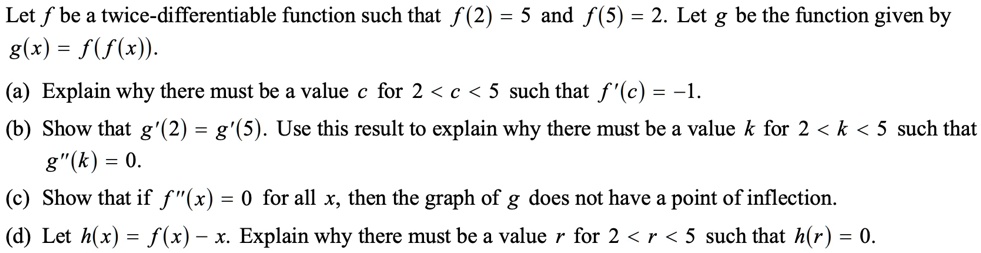
Let f be a twice-differentiable function such that f(2)=5 and f(5)=2. Let g be the function given by g(x)=f(f(x)).
(a) Explain why there must be a value c for f^(')(c)=-1g^(')(2)=g^(')(5)kg^('')(k)=0f^('')(x)=0xgh(x)=f(x)-xrh(r)=02 such that h(r)=0.2 such that g^('')(k)=0.
(c) Show that if f^('')(x)=0 for all x, then the graph of g does not have a point of inflection.
(d) Let h(x)=f(x)-x. Explain why there must be a value r for 2 such that h(r)=0.2 such that f^(')(c)=-1.
(b) Show that g^(')(2)=g^(')(5). Use this result to explain why there must be a value k for 2 such that g^('')(k)=0.
(c) Show that if f^('')(x)=0 for all x, then the graph of g does not have a point of inflection.
(d) Let h(x)=f(x)-x. Explain why there must be a value r for 2 such that h(r)=0.
Let f be a twice-differentiable function such that f(2) = 5 and f(5)= 2. Let g be the function given by g(x)=f(f(x)).
(a) Explain why there must be a value c for 2 < c < 5 such that f '(c) = -1.
(b Show that g'2)= g5).Use this result to explain why there must be a value k for 2< k < 5 such that g"(k) =0.
(c) Show that if f"(x) = 0 for all x, then the graph of g does not have a point of inflection
(d) Let h(x)=f(x) - x. Explain why there must be a value r for 2< r < 5 such that h(r) = 0