3. EXAM PAPER 2022 - [35 marks]
The director of the local tourist board is interested in determining the factors that
influence the hotel occupancy rate in her city each month. Hotel occupancy can be
measured as the percentage of available hotel rooms that are occupied by paying cus-
tomers. She develops the following model:
$Y = \beta_0 + \beta_1X_1 + \beta_2X_2 + \beta_3X_3 + \epsilon$
where
Y: hotel occupancy rate
$X_1$: the total number of passengers arriving at the airport
$X_2$: price index of local hotel room rates
$X_3$: a dummy variable, which takes a value of 1 during the months
of June, July, and August (and 0 otherwise)
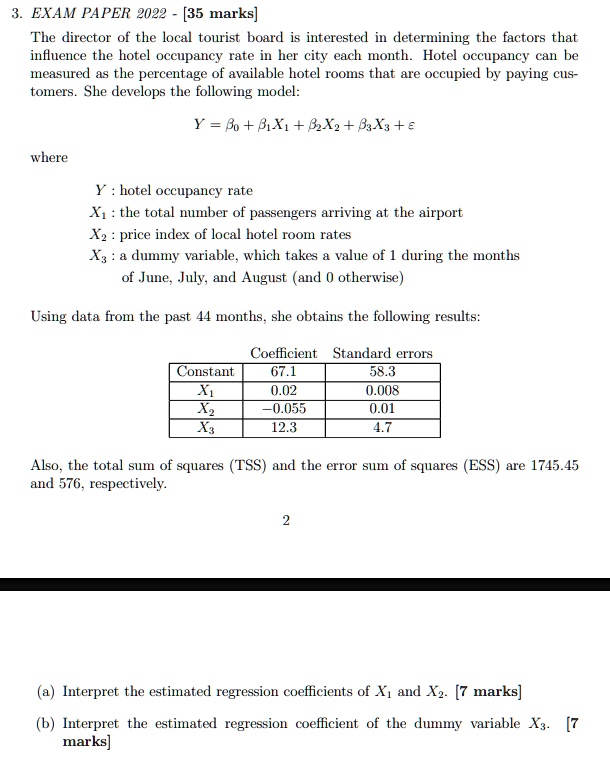
Using data from the past 44 months, she obtains the following results:
\begin{tabular}{|l|l|l|}
\hline
& Coefficient & Standard errors \\
\hline
Constant & 67.1 & 58.3 \\
$X_1$ & 0.02 & 0.008 \\
$X_2$ & -0.055 & 0.01 \\
$X_3$ & 12.3 & 4.7 \\
\hline
\end{tabular}
Also, the total sum of squares (TSS) and the error sum of squares (ESS) are 1745.45
and 576, respectively.
2
(a) Interpret the estimated regression coefficients of $X_1$ and $X_2$. [7 marks]
(b) Interpret the estimated regression coefficient of the dummy variable $X_3$. [7
marks]