Ace - AI Tutor
Ask Our Educators
Textbooks
My Library
Flashcards
Scribe - AI Notes
Notes & Exams
Download App
tom cox

tom c.

Divider

Questions asked

BEST MATCH

Consider the reversible reaction. $$PCl_5 \rightleftharpoons PCl_3 + Cl_2$$ What substances are present at equilibrium? $$PCl_3$$ $$PCl_5$$ $$Cl_2$$ Are the concentrations of phosphorus pentachloride, $$PCl_5$$, and phosphosphorus trichloride, $$PCl_3$$, constant or changing at equilibrium? The concentrations of both $$PCl_5$$ and $$PCl_3$$ are constant at equilibrium. The concentration of $$PCl_5$$ is changing, and the concentration of $$PCl_3$$ is constant at equilibrium. The concentration of $$PCl_5$$ is constant, and the concentration of $$PCl_3$$ is changing at equilibrium. The concentrations of both $$PCl_5$$ and $$PCl_3$$ are changing at equilibrium. How does the equilibrium change if more chlorine, $$Cl_2$$, is added to the reaction? The equilibrium does not shift to either the left or the right. The equilibrium shifts to the left. The equilibrium shifts to the right. If more phosphorus pentachloride, $$PCl_5$$, is added, how does the equilibrium change? The equilibrium shifts to the left. The equilibrium does not shift to either the left or the right. The equilibrium shifts to the right.

View Answer
divider
BEST MATCH

๊ทธ๋ฆผ 3.40๊ณผ ๊ฐ™์ด ๋ฌด๊ฒŒ 1,500N์˜ ์ด๋“ฑ๋ณ€์‚ผ๊ฐํ˜• ์ˆ˜๋ฌธ์ด A์ ์—์„œ ํžŒ์ง€๋กœ ๊ณ ์ •๋˜์–ด ์žˆ๋‹ค. ์ˆ˜๋ฌธ์„ ์œ ์ง€ํ•˜๊ธฐ ์œ„ํ•ด B์ ์— ์ˆ˜ํ‰์œผ๋กœ ๊ฐ€ํ•ด์•ผ ํ•  ํž˜์€ ์–ผ๋งˆ์ธ๊ฐ€? ๊ธฐ๋ฆ„ (๋น„์ค‘ 0.83) 3m ํ˜„์ง€ 1m ๋ฌด๋ฆฌ์‹ฑํฌ 5294 ์ˆ˜๋ฌธ A 2m 50ยฐ B ๊ทธ๋ฆผ 3.40 P

View Answer
divider
BEST MATCH

Question 3 Solve the following equation using the Quadratic Formula. Separate multiple solutions with a comma. If there is no real solution, enter None. x^(2)+5x-36=0

View Answer
divider
BEST MATCH

ETL stands for which process for scrubbing raw data to make it ready for analysis? Multiple choice question. Extract, Translate, and Load Extract, Transform, and Load Evaluate, Translate, and Load Extrapolate, Transform, and Load

View Answer
divider
BEST MATCH

Multiple Select Question Select all that apply Which of the following transactions would be reported under cash flows from operating activities? ? Cash received from sales ? Cash paid for salaries and wages ? Cash received from sale of investments ? Cash paid to lends for interest ? Cash paid for equipment

View Answer
divider
BEST MATCH

2. A pipeline \( A B C 180 \mathrm{~m} \) long is laid on an upward slope of 1 in 60 . The length of the portion \( A B \) is 90 m and its diameter is 150 mm . At \( B \) the \( \qquad \) pipe section suddenly enlarges to 300 mm diameter and remains so for the remainder of its length BC, 90 m . A flow of \( 0.05 \mathrm{~m}^{3} / \mathrm{s} \) is pumped into the pipe at its lower end A and is discharged at the upper end C into a closed tank. The pressure at the supply end \( A \) is \( 140 \mathrm{kN} / \mathrm{m}^{2} \mathrm{~A} \). (i) Find the pressure at the discharge end C ; (ii) Draw energy gradient line and hydraulic gradient line.

View Answer
divider
BEST MATCH

LIST some of the consequences that disease prevention and control may have on individual patients, and some of the consequences to public health if the practice were eliminated.

View Answer
divider
BEST MATCH

How do I fix these two codes that go together in Github based on the problems at the bottom? #4 J DebugFour4.java 1 X J DebugTrip.java 1 X Welcome Companion .. J DebugFour4.java > DebugFour4 > main(String[]) 4 import java.util.Scanner; 5 public class DebugFour4 6 Run | Debug 7 public static void main(String[] args) 8 9 Scanner input = new Scanner(System.in); 10 System.out.println("Enter destination city >> Chicago "); 11 String destinationCity = input.nextLine(); 12 System.out.println("Enter destination city >> Seattle"); 13 destinationCity = input.nextLine(); 14 System.out.println("Enter mode of transportation >> Train "); 15 String destinationMode = input.nextLine(); 16 DebugTrip trip1 = new DebugTrip(destinationCity); 17 DebugTrip trip2 = new DebugTrip(destinationCity, destinationCity); 18 DebugTrip trip3 = new DebugTrip(destinationCity, destinationCity, destinationCity); 19 display(trip1); 20 display(trip2); 21 display(trip3); 22 23 24 25 public static void display(DebugTrip trip) 26 27 System.out.println("Going to " + trip.getDestination()); 28 System.out.println("Leaving from " + trip.getDepartureCity()); 29 System.out.println("Going by " + trip.getMode()); 30 J DebugTrip.java > DebugTrip > DebugTrip(String, String) public class DebugTrip 10 11 12 13 14 15 16 17 18 19 20 21 22 23 24 25 26 27 28 29 30 31 32 33 34 35 36 37 38 39 40 41 42 private String destination; private String departure; private String mode; private static final String DEFAULT_CITY = "Atlanta"; private static final String DEFAULT_MODE = "car"; public DebugTrip() {}; // Do not remove this line public DebugTrip(String destination) this(destination, DEFAULT_CITY, DEFAULT_MODE); public DebugTrip(String destination, String departure) this(destination); this(departure); public DebugTrip(String destination, String departure, String mode) this.destination = destination; this.departure = departure; this.mode = mode; public String getDestination() return destination; public String getDepartureCity() return departure; public String getMode() return mode; PROBLEMS 2 OUTPUT DEBUG CONSOLE TERMINAL PORTS1 V J DebugTrip.java Constructor call must be the first statement in a constructor Java1207959691 [Ln 23, Col 8] J DebugFour4.java Resource leak: 'input' is never closed Java536871799) [Ln 9, Col 15] Filter (e.g. text, **/*.ts, !**/node_modules/**) YOEXX
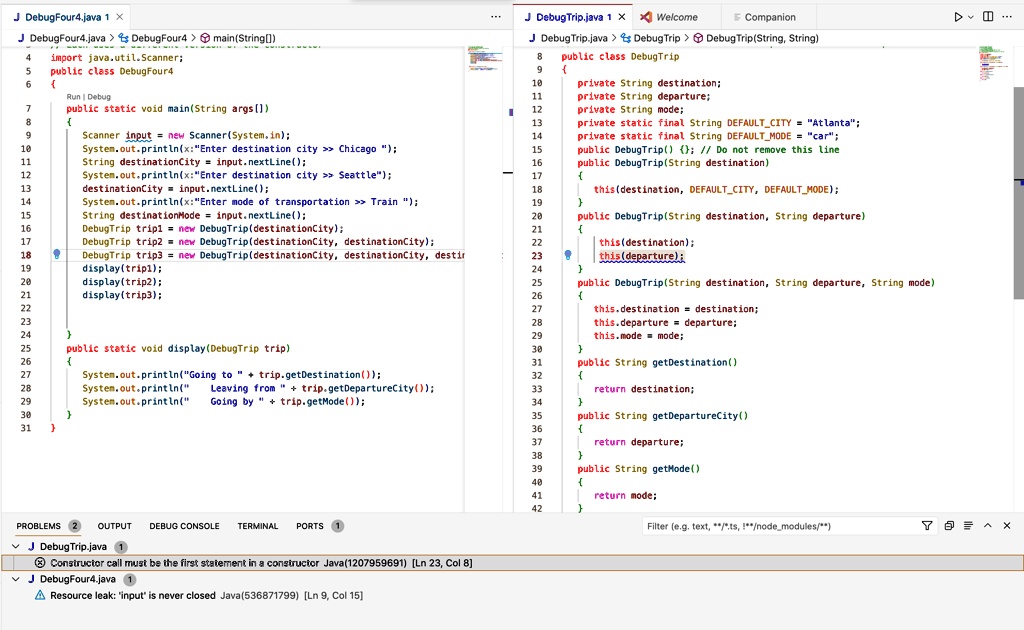
View Answer
divider
BEST MATCH

Exercise 2.1.12: In trying to solve a linear ODE written in the form u'(t) - h(t)u(t) = g(t), (2.20) itโ€™s not at all obvious how anyone might hit upon the idea of multiplying both sides of (2.20) by e^(-H(t)) where H'(t) = h(t). One way you might arrive at this inspiration is to note that the left side of (2.20) looks a little like the result of applying the product rule for derivatives to the product w(t)u(t) for some function w(t), namely (w(t)u(t))' = w(t)u'(t) + w'(t)u(t), (2.21) Chapter 2. First-Order Equations although the left side of (2.20) and the right side of (2.21) arenโ€™t quite the same. But if we multiply the left side of (2.20) by an arbitrary function w(t) we obtain w(t)u'(t) - w(t)h(t)u(t), and comparison to the right side of (2.21) shows that the w(t)u'(t) terms will match no matter what we choose for w(t). If we can choose w(t) so that -w(t)h(t)u(t) = w'(t)u(t) then weโ€™re in business: the quantity w(t)u'(t) - w(t)h(t)u(t) will be an exact derivative. Show that the condition -w(t)h(t)u(t) = w'(t)u(t) leads to the conclusion that w(t) = e^(-H(t)), where H'(t) = h(t). This is precisely the integrating factor in (2.10).

View Answer
divider
BEST MATCH

3. (a) The blue colour of copper sulphate solution disappears slowly on keeping when a zinc rod is into its solution, explain with reason.

View Answer
divider