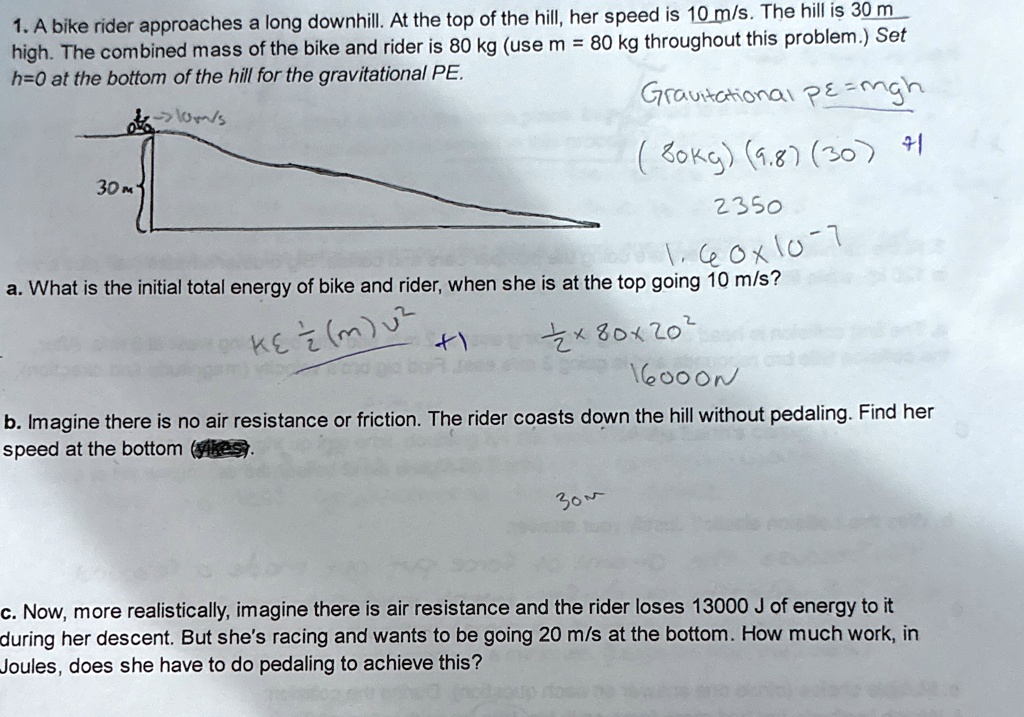
1. A bike rider approaches a long downhill. At the top of the hill, her speed is 10 m/s. The hill is 30 m
high. The combined mass of the bike and rider is 80 kg (use m = 80 kg throughout this problem.) Set
h=0 at the bottom of the hill for the gravitational PE.
30m
10m/s
Gravitational pe=mgh
(80kg) (9.8) (30) +1
2350
1.60x10⁻⁷
a. What is the initial total energy of bike and rider, when she is at the top going 10 m/s?
KE = \frac{1}{2}(m)v^2
+1
\frac{1}{2} \times 80 \times 20^2
160000
b. Imagine there is no air resistance or friction. The rider coasts down the hill without pedaling. Find her
speed at the bottom (vikes).
30~
c. Now, more realistically, imagine there is air resistance and the rider loses 13000 J of energy to it
during her descent. But she's racing and wants to be going 20 m/s at the bottom. How much work, in
Joules, does she have to do pedaling to achieve this?